Two Magento stores can carry identical products, identical schema, and identical SEO. One appears inside ChatGPT Shopping. The other never does.
The difference is not better optimisation. It is that ChatGPT, Google, and Perplexity do not discover products the same way — and a store optimised for one of those pipelines can be structurally invisible to the other two.
Verified July 2026 against vendor documentation and reporting. AI shopping surfaces change monthly — protocol versions, regional availability, and crawler names should be re-checked against primary sources before you implement anything here.
TL;DR — 2 minute version
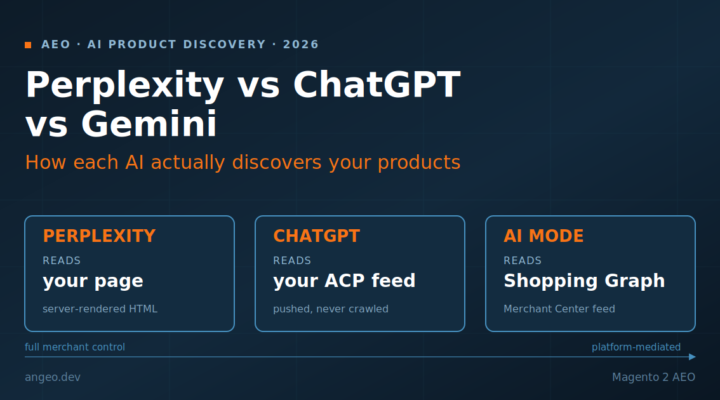
- Each engine leans on a different primary source. ChatGPT’s shopping results run on a feed you push to OpenAI — but its Shopping Research mode reads retailer product pages directly. Google AI Mode reads the Shopping Graph, built mainly from your Merchant Center feed. Perplexity mostly reads your actual page.
- “Which AI engine is better” is the wrong question. You are present on all three or absent from all three. The real decision is sequencing — which channel to build first given your market and platform.
- For most EU merchants today, Perplexity is the fastest channel to become visible, because it currently has the fewest onboarding barriers.
- Crawler access and product feeds serve different surfaces. Crawlers earn citations in conversational answers. Feeds earn placement in shopping results. Doing one does not deliver the other.
- The underlying product data is largely shared across ACP, UCP, and Merchant Center. Build one clean dataset, emit three shapes.
How AI product discovery actually flows
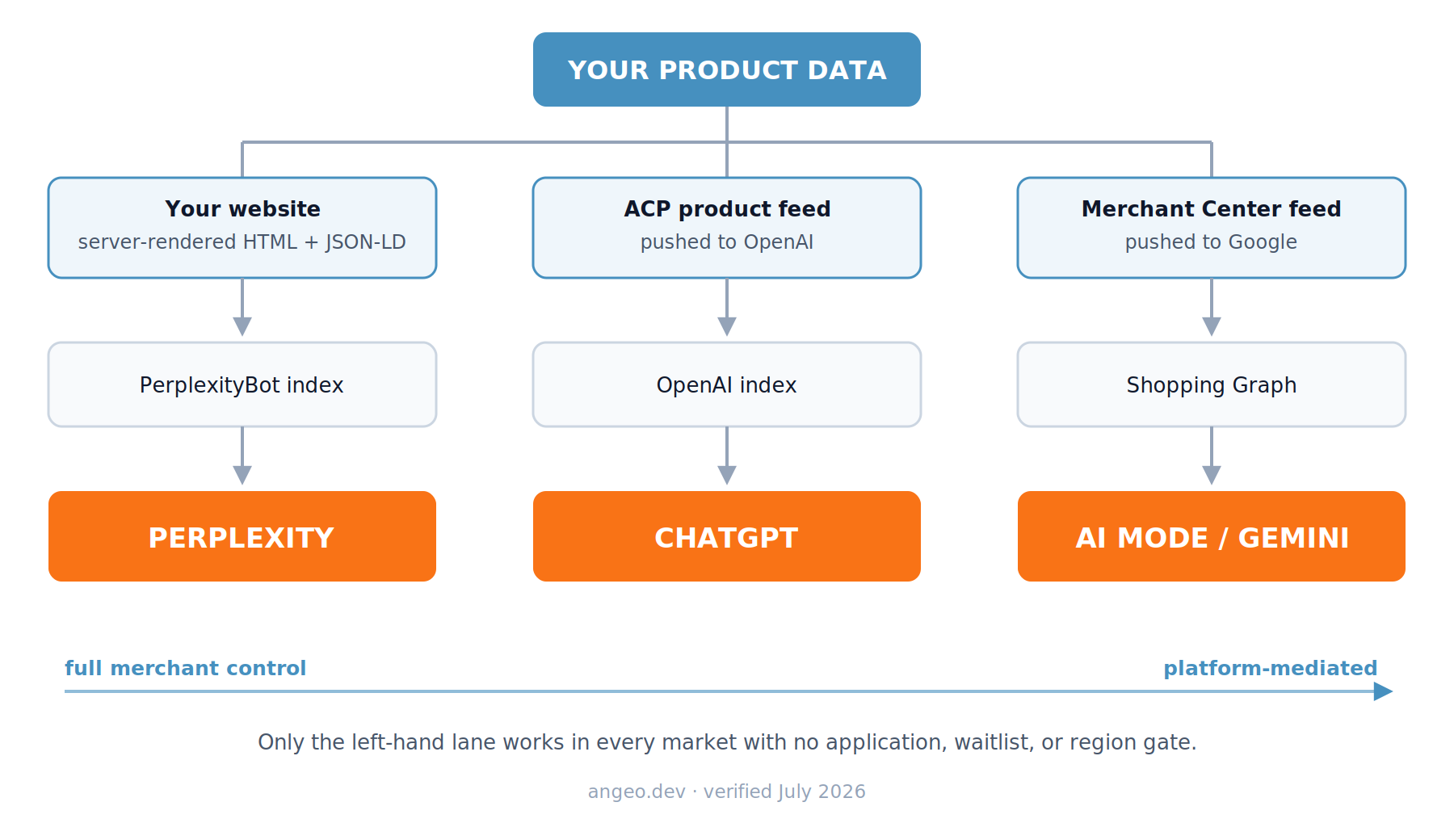
Read left to right, the merchant’s control decreases and the platform’s mediation increases. On the left you own the artefact outright. On the right you are supplying a database you do not operate, and the shopper may never touch your site at all.
The distinction that explains everything else
Each of these platforms runs more than one pipeline, and almost every AEO checklist collapses them into one.
The citation surface answers “what is the best way to do X” with numbered sources. It is fed by web crawling. Your pages, schema, llms.txt, and robots.txt rules all live here.
The shopping surface answers “best waterproof hiking boots under €150” with a product carousel showing prices and availability. On ChatGPT and Google this runs primarily on structured product feeds rather than on a crawl of your site.
This is why merchants who correctly allow every AI crawler and publish flawless JSON-LD still find their SKUs missing from ChatGPT product comparisons. The crawler work was not wasted; it was aimed at a different surface.
ChatGPT complicates the picture in a way worth stating up front, because it cuts against the simple version of this rule. Alongside feed-driven results it runs Shopping Research, an agentic mode that browses in real time. OpenAI describes its results as organic and based on publicly available retail sites, reading product pages directly and citing sources, with a separate allowlisting process for merchants who want to be eligible. So on ChatGPT there are effectively three routes, not two — and page quality is an input to one of them.
The practical takeaway is not “pages don’t matter for shopping.” It is that feeds and pages feed different surfaces, and neither substitutes for the other. Everything below follows from that.
Side by side
| ChatGPT (OpenAI) | Perplexity | Google AI Mode / Gemini | |
|---|---|---|---|
| Primary product source | ACP feed, pushed by merchant | Live page retrieval + optional Merchant Program | Shopping Graph, from Merchant Center |
| Reads your product page for shopping? | Not for feed-driven results; Shopping Research reads retailer pages directly | Yes, primarily | Secondary — schema.org markup contributes to the Shopping Graph |
| Index crawler | OAI-SearchBot | PerplexityBot | Googlebot |
| Training crawler | GPTBot | — | (controlled via Google-Extended) |
| Live user-triggered fetch | ChatGPT-User | Perplexity-User | — |
| Honours robots.txt on live fetch | Yes | Documented as generally not | n/a |
| Shopping features available to users | Broadly available | Broadly available | Rolling out by surface and region |
| Merchant onboarding barrier | Direct feed access by application; Shopping Research by allowlist | Free program, ~5 minutes | Merchant Center account; UCP capabilities staged |
| Agentic checkout | ACP (scope narrowed March 2026) | Instant Buy, PayPal-backed | UCP + Universal Cart |
| Strongest reported signal | Feed completeness | Recency | Feed accuracy + conversational attributes |
| Citation transparency | Moderate | High — numbered, linked | Low |
Where to start: a decision table
| If you are… | Start with… | Because |
|---|---|---|
| A US merchant | ACP feed | Feed access is open to you and it is the primary input to feed-driven shopping results |
| An EU / UK merchant | Perplexity | The channel with the fewest onboarding barriers right now |
| A large brand with an existing catalog operation | Merchant Center | You already have the feed; depth and conversational attributes are the gap |
| Content-led, not catalog-led | OAI-SearchBot access | Your value is citations in answers, not product carousels |
| On Hyvä or headless | Page-level schema | Your rendering layer is the constraint before any feed work matters |
| B2B / quote-based | Page-level schema + llms.txt | No shopping surface applies; you compete for citations in procurement research |
Two caveats on reading this table. First, “start with” is not “only do” — these channels compound, and the sequence is about where the first month of work returns most. Second, every row assumes the technical floor is already in place: server-rendered content, valid Product schema, and crawler access. Without that floor, no feed rescues you.
ChatGPT: the feed carries the catalog, the page still carries the story
The consequential fact about ChatGPT’s feed-driven shopping results is that product data is not crawled — the merchant pushes a structured file to a secure OpenAI endpoint. Through the Agentic Commerce Protocol, merchants share product feeds and promotions so their catalogs are represented in ChatGPT, with delivery paths including third-party providers such as Salesforce and Stripe.
This changed direction in March 2026, and much published guidance has not caught up: OpenAI stepped away from Instant Checkout and put its weight behind product discovery instead. The ambition of buying without leaving the chat gave way to a more modest, more durable mechanism — get the catalog data right, let the purchase complete on the merchant’s site.
Shopping Research sits alongside that. It is an agentic mode that runs real-time searches and assembles a buyer’s guide, and OpenAI states plainly that results are organic and based on publicly available retail sites — reading product pages directly, citing sources, and avoiding low-quality sites. Merchants who want to be eligible follow a separate allowlisting process. If you have concluded from the feed architecture that your product pages are irrelevant to ChatGPT, this is the correction: they are irrelevant to one surface and load-bearing on another.
Shopify and Etsy catalogs are already integrated with no additional setup. OpenAI has said a self-serve merchant platform is coming, with expansion to more merchants and regions over time.
The crawlers serve the citation surface. OpenAI runs GPTBot for training, OAI-SearchBot for ChatGPT search visibility, and ChatGPT-User for user-triggered fetches, plus an ads agent. The split is load-bearing: blocking GPTBot opts you out of training while allowing OAI-SearchBot keeps you citable in ChatGPT. Merchants who blanket-block “OpenAI” usually intend the former and accidentally do the latter.
Worth knowing for measurement: log-file analysis suggests ChatGPT-User traffic has declined while OAI-SearchBot crawling has risen, consistent with OpenAI building its own index rather than fetching pages in real time. Monitoring a single user agent will mislead you.
Largest LLM search audience; merchant-controlled feed data with frequent refresh; results are organic rather than paid; page quality still counts on the Shopping Research surface.
Direct feed access is gated by application; two separate onboarding paths to manage; feed quality, not page quality, is what drives feed-driven placement.
Magento path: robots.txt rules per bot for the citation and research surfaces, ACP feed for the shopping surface.
Perplexity: the engine where your HTML is the main input
Perplexity’s architecture is different, and for a Magento merchant that difference is favourable.
It uses two agents: PerplexityBot builds the search index and obeys robots.txt, while Perplexity-User fetches pages live and, by Perplexity’s own documentation, generally ignores robots.txt. A well-structured product page can therefore be read and cited with no feed, no application, and no regional eligibility.
Independent analyses consistently suggest freshness is among the strongest observed signals here — more so than on the other engines — which makes refreshing existing pages higher-yield than publishing new ones. Perplexity does not publish ranking factors, so treat that as an observed pattern rather than a documented rule.
There is an optional layer on top: the Perplexity Merchant Program is free, takes about five minutes to apply for, and provides better product indexing, in-chat checkout capability, and performance data. It is additive rather than gatekeeping.
Measurement is the cleanest of the three. Every answer ships with numbered citations linked to source URLs, which makes it one of the easiest engines for citation-share measurement — you can count citations directly per prompt rather than inferring them.
Two caveats stated plainly rather than buried. Perplexity’s crawling practices are contested: Cloudflare published research in August 2025 alleging undeclared “stealth” crawlers reaching content on sites that had blocked all bots, which Perplexity disputed as user-driven, browser-like fetches. And there is active legal exposure — Amazon filed suit in March 2026 accusing Perplexity of scraping product pages and reviews without authorisation, alongside a preliminary injunction granted the same month against the Comet browser agent, on the reasoning that accessing logged-in areas without authorisation constitutes unauthorised access even with user permission. That ruling constrains what any agent may do inside authenticated areas of a store, not just Perplexity’s.
Lowest onboarding barrier of the three; transparent citations make measurement trivial; page quality translates directly into visibility.
Smaller audience than ChatGPT or Google; legal and reputational volatility; recency requirement means content decays without maintenance.
Magento path: this is where server-rendered, schema-complete pages pay off immediately. If you run Hyvä, check the Product entity gap — Perplexity is the engine most likely to be reading that markup rather than a feed.
Google: the feed is the front door
Google leans on structured feeds more heavily than on your site. AI Mode draws on the Shopping Graph, populated from Merchant Center feeds and schema.org Product markup — the feed is the primary structured source, while website markup continues to contribute.
Merchant Center’s role expanded substantially through 2026: it is no longer just a backend for Google Shopping ads, but the source of truth for agentic discovery, with onboarding simplified specifically for Universal Commerce Protocol integration.
The protocol layer sits on top. UCP was announced on 11 January 2026 at NRF, co-developed with Shopify, Etsy, Wayfair, Target, and Walmart and endorsed by more than twenty additional companies; it defines how AI agents discover products, negotiate checkout parameters, link identities, and manage the post-purchase lifecycle. Visibility and transactability are separate flags: a product can appear in AI Mode without the native_commerce attribute, but will not be purchasable there without a click-through.
The May 2026 expansion matters for planning. At Google Marketing Live on 20 May 2026, Google announced Universal Cart with cross-retailer support across Search, Gemini, YouTube, and Gmail, Affirm and Klarna embedded in Google Pay, UCP checkout extended to YouTube Shopping ads, and geographic expansion to Canada, Australia, and the UK. Merchant-side measurement shipped alongside: AI performance insights in Merchant Center compare a brand’s share of voice on AI surfaces against similar brands, with conversational attributes for updating product descriptions to match how people actually ask.
Note what is missing from Google’s column: a dedicated AI crawler. Google-Extended is a training-control token, not a bot. Googlebot does the crawling, and AI commerce visibility runs largely through the feed.
Largest commercial intent volume; you likely already have the feed; native measurement in Merchant Center.
Least merchant control; opaque selection; site markup is a supporting rather than deciding input; UCP capabilities still rolling out by region and cohort.
Magento path: UCP readiness checklist and what UCP means for store owners.
The geography most guides skip
Read the three sections together and a pattern appears that reorders the work for anyone outside the United States. It only shows up if you separate two things that get reported as one.
Availability of shopping features to users is broad. Shoppers in many markets can already ask ChatGPT or Google for product recommendations and get them.
Availability of merchant onboarding is not. Direct ACP feed access runs through an application process with staged rollout. UCP checkout began in the US and extended to Canada, Australia, and the UK by May 2026, with capabilities arriving by cohort. Perplexity’s Merchant Program is open, free, and immediately actionable anywhere.
That gap is the thing to plan around. Your customers may already be asking these engines about products like yours while your ability to supply structured data to two of the three is still queued. That does not make feed work pointless — ACP and UCP consume largely the same clean product data, and a store that builds it now is ready when access opens rather than starting from zero. But it does mean the work you can complete today is page-level, and the work you can only prepare today is feed-level.
This is the practical case for merchant-controlled AEO: the artefacts you own outright work in every market on every engine, while the platform-mediated channels arrive on someone else’s schedule.
Verify what is actually reaching your store
Check your own logs rather than trusting anyone’s summary, including this one:
grep -Eo "GPTBot|OAI-SearchBot|ChatGPT-User|PerplexityBot|Perplexity-User|Googlebot" \
  /var/log/nginx/access.log | sort | uniq -c | sort -rn
Adjust the path for your stack. You want OAI-SearchBot and PerplexityBot appearing regularly — those are the index builders. Their absence usually means a robots.txt rule, a WAF rule, or a CDN bot-management setting doing something you did not intend. Firewall blocking is invisible in robots.txt: your rules can be perfectly permissive while Cloudflare or your host silently rejects the request.
For the traffic side, see tracking AI search traffic in Magento 2.
What we are not certain about
- Ranking mechanics are opaque on all three. Perplexity has not published a ranking algorithm; OpenAI describes results as organic and unsponsored without detailing weighting; Shopping Graph selection logic is undocumented. Any “top three ranking factors” claim for these engines is inference from correlation, not a vendor statement.
- How much the two ChatGPT surfaces overlap is unclear. Feed-driven results and Shopping Research are documented separately, but how a merchant’s presence in one affects the other is not something OpenAI has spelled out.
- The Perplexity crawling dispute is unresolved. Cloudflare’s allegations and Perplexity’s rebuttal are genuinely different framings of the same fetches, and we have no independent basis to adjudicate.
- Reported adoption figures vary widely by source. We have deliberately omitted most of them; the circulating AI shopping growth numbers use incomparable methodologies.
- Regional availability moves faster than any published guide. Re-verify the geography section before it drives a budget decision.
- We are a vendor in this category. We build open-source Magento AEO modules, and the recommendation to prioritise page-level readability aligns with what those modules do. Treat it as a claim to check rather than accept.
FAQ
Do I need three separate product feeds?
The underlying data is largely shared — titles, descriptions, price, availability, shipping and return policy, identifiers. Only the formats and endpoints differ. One canonical dataset emitting three shapes is far less work than three pipelines. See the ACP vs UCP comparison.
If a feed drives ChatGPT shopping results, does robots.txt still matter?
Yes, on two counts. OAI-SearchBot access determines whether your content can be cited in ChatGPT answers at all. And Shopping Research reads retailer product pages directly, so blocking crawlers can affect that surface too.
Which engine should a small EU Magento store target first?
Perplexity, on onboarding grounds: good page markup produces results there with no application and no queue, while direct feed access elsewhere is still staged.
Does llms.txt help with any of this?
It is a content map for the citation surface, not an input to any shopping feed. Perplexity has been the most publicly supportive of the proposal. See generating llms.txt for Magento 2.
Is Gemini different from Google AI Mode?
For product discovery they draw on the same Shopping Graph infrastructure, and the Universal Cart rollout spans Search, Gemini, YouTube, and Gmail as connected surfaces rather than separate pipelines.
Sources
- OpenAI — Powering product discovery in ChatGPT (March 2026)
- OpenAI — Introducing shopping research in ChatGPT
- OpenAI Help Center — Using shopping research in ChatGPT
- OpenAI Help Center — Shopping with ChatGPT search
- OpenAI Developers — Agentic Commerce product feed specification
- OpenAI — crawler and user-agent documentation
- Google — Shopping updates at Google Marketing Live (May 2026), blog.google
- Google Merchant Center documentation on UCP and
native_commerce - Perplexity — crawler documentation and Merchant Program pages
- Botify — OpenAI crawler log-file analysis (May 2026)
- Cloudflare — crawler research (August 2025); Perplexity’s published response
- Reuters — reporting on Amazon v. Perplexity (March 2026)
Written by Ievgenii Gryshkun, angeo.dev — Magento 2 AEO. We build free, MIT-licensed AEO modules for Magento 2. Run a free AEO audit.