UCP is an actively evolving protocol — capabilities, naming, and rollout status may change. Last verified against UCP spec version 2026-08-25.
TL;DR — 2 minute version
- UCP (Universal Commerce Protocol) is an open standard that lets AI agents discover, browse, and transact with merchant backends
- Announced January 2026 at NRF, significantly expanded at Google Marketing Live on May 20, 2026
- Google has announced UCP integration across AI Mode, Gemini, YouTube Shopping, and Gmail — rollout timing varies by surface and market
- Launch partners include Nike, Sephora, Target, Walmart, Wayfair, and Shopify merchants
- Magento has no built-in UCP support. The
angeo/module-ucpmodule publishes a spec-compliant UCP profile, andangeo/module-ucp-catalogserves the catalog endpoints - UCP makes your store discoverable to AI agents. It does not guarantee recommendations — that depends on catalog quality, pricing, schema, and authority
On 20 May 2026, Google made an announcement that most store owners missed.
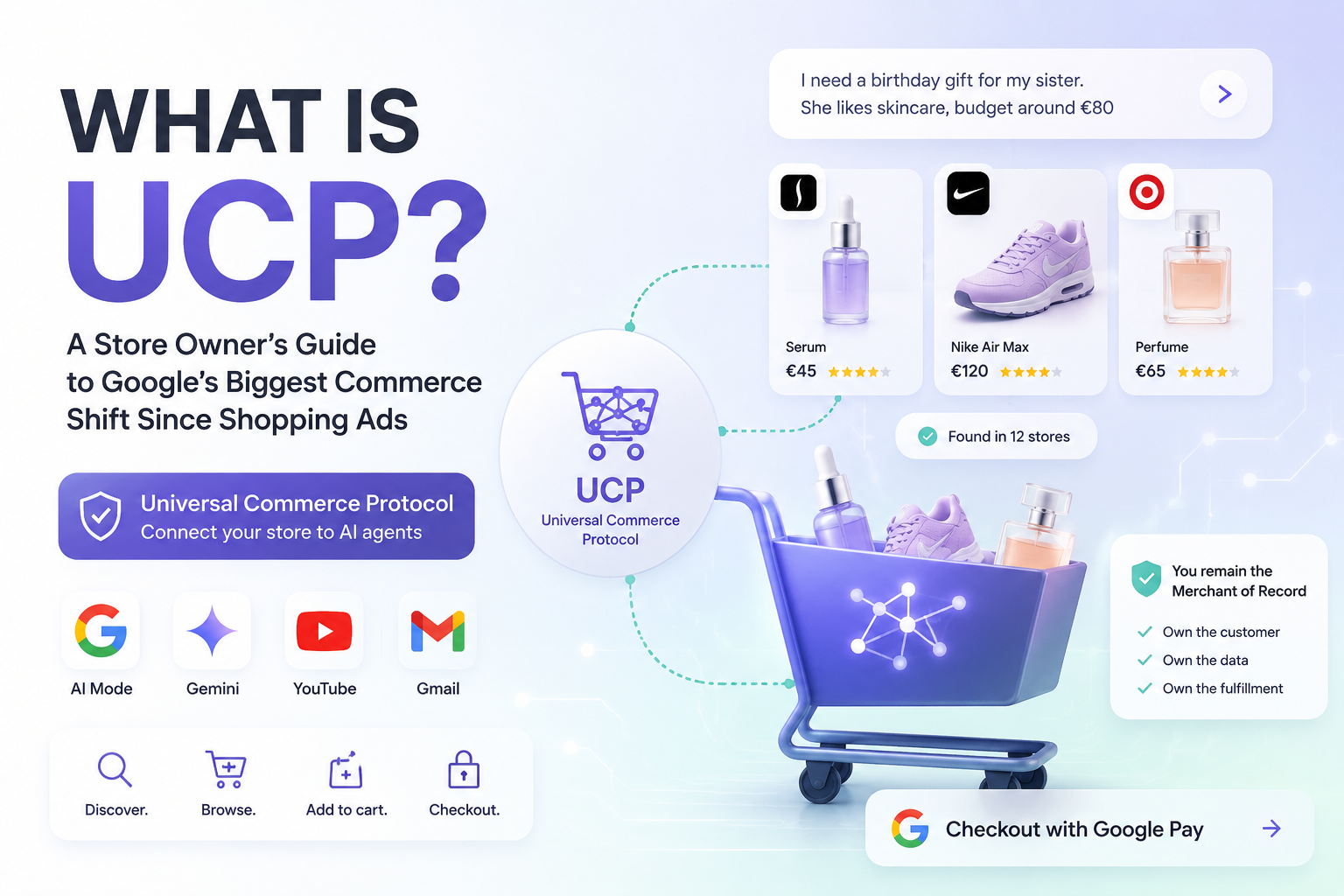
At Google Marketing Live 2026 on May 20, the company launched Universal Cart — a cross-merchant shopping cart that works across Google Search, Gemini, YouTube, and Gmail. As demonstrated on stage, a customer could add Nike shoes from a YouTube video, skincare from Sephora through Gemini, and check out everything in one tap with Google Pay.
The commerce infrastructure underlying these experiences is built on what Google calls UCP — the Universal Commerce Protocol. UCP is one of several emerging standards designed to let AI agents interact with merchant backends.
If you run a Magento store, you are not in that system by default. But it may be possible to change that.
This guide is part of the Merchant-Controlled AEO architecture — the approach where the merchant owns every signal between their catalog and the AI layer.
The shift that changed everything
For twenty years, getting found online meant one thing: rank on Google. You hired an SEO agency, built backlinks, optimised page speed, and waited for position one.
That still matters. But it is no longer the only path to discovery.
In 2025, customers started asking questions instead of searching for links. “Best ergonomic chair under €400.” “Which outdoor furniture brand delivers to Belgium?” “Compare these two coffee machines for me.”
They are not always typing these questions into Google. They are typing them into ChatGPT, Gemini, and Perplexity — and getting a direct answer: one store, two stores, a specific recommendation. No list of ten results to browse. Just an answer.
As of Google I/O 2026, AI Mode has surpassed one billion monthly users. That number was effectively zero eighteen months ago.
So what is UCP?
UCP stands for Universal Commerce Protocol.
It is an open standard that lets AI agents discover your catalog, build a cart, and — in supported flows — complete a purchase, potentially without the customer visiting your website directly.
The goal is simple: when an AI agent (like Gemini) is asked about what you sell, it can find your store, understand what you offer, and facilitate a transaction.
What does that actually look like?
This is the type of workflow Google demonstrated at Google Marketing Live 2026 and is actively rolling out with launch partners:
A customer opens the Gemini app and says: “I need a birthday gift for my sister. She likes skincare, budget around €80.”
Gemini searches across UCP-connected stores, finds matching products, and shows them with prices, reviews, and availability — inside the chat. The customer taps “Add to cart.” She opens YouTube later and sees a video mentioning a perfume. She adds that too.
Products from different stores sit in one Universal Cart. She can check out with Google Pay or transfer items to the merchant’s own checkout page — both paths are supported.
The stores remain the Merchant of Record throughout. They own the transaction, the customer data, and the fulfilment. UCP facilitates the communication between the AI agent and their backend.
How is this different from what we had before?
Before UCP, every AI platform needed its own integration.
ChatGPT built its own shopping system — the Agentic Commerce Protocol (ACP). If you wanted your products in ChatGPT Shopping, you needed to register a separate product feed, meet OpenAI’s specific requirements, and wait for approval.
Google had its own integrations. Shopify had its own. Every surface required custom work.
UCP is designed to change this. It is a single protocol — with broad industry participation — that aims to work across any AI surface that supports it. One implementation, multiple platforms.
Google has announced UCP integration across AI Mode, Gemini, YouTube Shopping, and Gmail — though feature completeness varies by surface and market. Microsoft has been named as joining the steering effort. More platforms may follow as the standard matures.
Why should a store owner care?
Three reasons.
1. This is where a growing segment of customers is heading.
Google AI Mode passed one billion monthly users as of May 2026. Universal Cart has begun rolling out in the US. If your products are not accessible through UCP, they cannot appear in Universal Cart, cannot be recommended by Gemini in shopping contexts, and cannot be purchased from YouTube — a growing set of purchase surfaces.
2. You remain the Merchant of Record.
This is the part that surprises most store owners. UCP is not Google taking over your transactions. The protocol explicitly preserves the merchant’s role: you own the customer relationship, the pricing, the fulfilment, the data. The customer can also choose to transfer items to your website and check out there — Universal Cart supports both in-app checkout and cart transfer.
3. Several major retailers have announced UCP participation.
Nike, Sephora, Target, Walmart, and Wayfair are named launch partners. Every Shopify merchant can opt in through their existing platform integration. If you sell in a category where any of these brands compete, their UCP presence means they may appear in AI agent recommendations where you currently do not — though the actual competitive impact depends on your category, market, and how quickly AI-driven shopping adoption grows in your customer base.
How does UCP work technically? (No code, I promise)
UCP works like a restaurant menu for AI agents.
Your store publishes a small file at a specific address — yourstore.com/.well-known/ucp — that tells AI agents what your store can do. Think of it as a menu: “Here is what I sell. Here are the services I offer. Here is how to place an order.”
When an AI agent (like Gemini) wants to recommend products from your store, it reads this menu first. Then it knows: can I search the catalog? Can I build a cart? Can I complete a checkout? The agent only uses the capabilities your store explicitly advertises.
This is called discovery and negotiation. The merchant declares what they support. The agent declares what it can handle. They compute the intersection and proceed with what both sides agree on.
The menu has five capability areas:
| Capability | What it does |
|---|---|
| Catalog | AI agents can search and browse your products |
| Cart | AI agents can create and manage shopping carts |
| Checkout | AI agents can initiate and complete purchases |
| Order | AI agents can check order status and handle returns |
| Identity Linking | Customers can connect their store account to their Google account |
You do not need all five on day one. The protocol is modular — you can start with just the discovery profile and add capabilities over time as the spec stabilises and your implementation matures.
What UCP does not do
UCP makes your store discoverable to AI agents that support the protocol. It does not guarantee that AI agents will recommend your products.
Recommendation depends on factors UCP does not control:
| Factor | Why it matters |
|---|---|
| Catalog quality | Complete, accurate product data with real descriptions — not supplier copy |
| Pricing competitiveness | AI agents compare across merchants when building recommendations |
| Review signals | aggregateRating in schema affects recommendation confidence |
| Entity authority | How well-known your brand is across the web — mentions, citations, links |
| Fulfilment reliability | Shipping times, return policies, in-stock accuracy |
| Schema completeness | JSON-LD with all required fields — especially offers.availability |
| Feed freshness | Stale data (wrong prices, out-of-stock items) erodes AI agent trust |
Think of UCP as opening the door. Everything else determines whether the AI agent walks through it and recommends you. A UCP profile without strong product data is a door with nothing behind it.
What about ACP — the ChatGPT protocol?
ACP and UCP are not competitors — they are complementary protocols targeting different AI platforms.
ACP (Agentic Commerce Protocol) is OpenAI’s standard for ChatGPT Shopping. UCP is the standard emerging around Google’s ecosystem — AI Mode, Gemini, YouTube, and Gmail. They target different AI platforms with different user bases.
Early data from merchants who have implemented both protocols suggests approximately 40% more agentic traffic compared to single-protocol stores — though this figure comes from a limited number of early adopters and may not generalise across all categories.
The practical recommendation: if AI commerce is strategically relevant to your business, implement both. The technical foundations — product feeds, structured data, catalog APIs — overlap significantly.
The Angeo module suite for Magento 2 covers both: angeo/module-openai-product-feed handles ChatGPT Shopping (ACP). angeo/module-ucp handles Google’s Universal Commerce Protocol. Both are open-source and run entirely on your Magento instance.
What does this mean for Magento stores specifically?
Here is the current reality: Magento has no built-in UCP support. Unlike Shopify, where UCP integration is available through the platform, Magento merchants need to implement UCP themselves — or use a module.
This is both a challenge and an opportunity.
The challenge: without action, your Magento store is not discoverable by AI agents using the UCP protocol — which Google is deploying across its commerce surfaces.
The opportunity: very few Magento stores have implemented UCP yet. Merchants who establish UCP presence early may have an advantage in categories where AI-driven discovery is growing — though UCP presence alone does not guarantee recommendation, as outlined above.
The angeo/module-ucp module (version 2.x, spec 2026-08-25) publishes a spec-compliant UCP profile at /.well-known/ucp with its public keys in keys[]. angeo/module-ucp-catalog serves the catalog search and lookup endpoints the profile advertises. Cart and checkout endpoints are not implemented yet.
gtstudio/module-ucp is another open-source UCP module for Magento 2 that goes further than the angeo module in its current release — it includes checkout session endpoints, quote management, and UcpSession persistence. If you need functional checkout capability today rather than profile-only discovery, it may be the better fit for your timeline. The angeo module prioritises a cautious, incremental approach — profile first, endpoints added as the spec stabilises. Both are valid strategies with different risk profiles.
Where to start
If you are not sure whether UCP is relevant to your store yet, start with two questions:
1. Do you sell in a category where Nike, Sephora, Target, Walmart, or Wayfair compete? If yes, those brands are named UCP launch partners. Their products may appear in AI agent recommendations where yours currently do not.
2. Do your customers use Google Search, Gemini, or YouTube? If yes — and they almost certainly do — UCP may eventually determine whether your products can appear when those customers are ready to buy.
The practical first step: run an AEO audit on your store. UCP readiness is part of the broader AI commerce picture — and most Magento stores have foundational issues (blocked crawlers, missing schema, no product feed) that need fixing before UCP adds value.
Is your store ready for AI agents?
The free scan checks 14 AEO signals — including the foundations UCP builds on. 30 seconds, no installation required.
Check your AI visibility →Sources and further reading
- Google Marketing Live 2026 — merchant and shopping updates (Google Blog, May 20, 2026)
- Universal Cart announcement — Google I/O 2026 (Google Blog, May 2026)
- UCP profile guide — Google for Developers (spec version 2026-04-08)
- Building the Universal Commerce Protocol — Shopify Engineering
- UCP GitHub repository (Apache License 2.0)
- UCP specification — core concepts (ucp.dev)
Related guides
Frequently asked questions FAQ schema
angeo/module-ucp module is MIT-licensed and free. Google does not charge merchants for UCP participation, per current announcements. The cost is implementation time — which for the profile-only layer is measured in minutes, not days.angeo/module-ucp requires Magento 2.4.7 or later, PHP 8.2+, and the OpenSSL extension. The alternative gtstudio/module-ucp module has similar requirements — check its Packagist page for specifics.