Magento does not ship a native stack for AI discovery. No llms.txt. No dedicated AI-bot policy in robots.txt. No agentic checkout. No MCP endpoint. Every one of those gaps is now filled by something the community built, and I spent the last weeks going through all of it.
The result is a list: awesome-magento-aeo. 42 projects, grouped by what they actually do. This post is the part the list can’t hold — what the distribution of those 42 projects tells you about where this field really is.
The finding
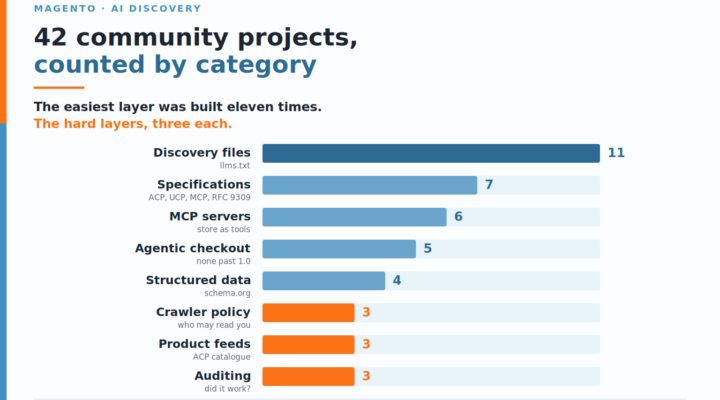
Eleven separate llms.txt implementations exist for Magento. Eleven. For a file format proposed in 2024 that is, at heart, a Markdown document at your site root.
Not one of those five agentic checkout projects is past a stable 1.0.
The ecosystem built the easiest layer eleven times and the hard layers three times each. That is the finding, and everything below is what it means.
Two categories have attracted repeated implementations — discovery files, and structured data, which is older and genuinely mature. Structured data carries only four entries, because its maturity sits in the standard rather than in the number of modules reimplementing it. Everything downstream of those two is early. The protocols themselves are still moving; ACP and UCP both changed shape during the months I was tracking them. MCP servers cluster around admin access, which is the harder security problem, rather than storefront access, which is the one shoppers actually touch.
Why eleven llms.txt modules is not a joke
The obvious reading is duplicated effort — everyone shipping the same weekend project. That reading is wrong, and it took me a while to see why.
Generating llms.txt for a real Magento store is not trivial. You hit multi-store layout, Page Builder content that has to be resolved rather than dumped as markup, CMS directives, customer-group pricing, and catalogs large enough that naive generation exhausts memory. The eleven implementations differ precisely on those axes: cursor-based pagination and PHP generators for large catalogs, store-scoped entity selection, weighted ranking and use-case grouping, blog posts feeding the file with IndexNow pinging.
They look identical from the outside and diverge completely at the point where Magento gets hard. That is what a young category looks like — several people solving the same problem, disagreeing about which parts matter.
What almost nobody has built
Crawler policy. Three entries. Deciding which AI crawlers may enter, verifying they are who they claim, and measuring what they took. A common failure in Magento stores is a robots.txt that appears to block AI crawlers and does not, because under RFC 9309 a matched user-agent group does not inherit rules from the wildcard group. Put your rules in User-agent: *, then add a User-agent: GPTBot group anywhere in the file, and GPTBot stops reading the first group entirely. It is one of the cheapest fixes in AEO and one of the least implemented.
Product feeds. Three entries. The feed shape is public and the work is unglamorous, which may be exactly why. Two of the three are mine, so this is also an area where my own work materially affects the shape of the list.
Auditing. Measuring whether any of it worked still happens mostly inside general SEO suites rather than AEO-specific tools. Crawl access, citation share, and rendering quality are three different questions, and most tooling answers at most one.
The category that got smaller while I was writing
The agentic checkout section is the one to read carefully, and not because the code is immature.
In March 2026, OpenAI pulled back from in-chat Instant Checkout. Only a small number of Shopify merchants had gone live with it — published figures range from about a dozen to around thirty — against the “over a million” named at launch six months earlier. The model moved toward product discovery inside ChatGPT, with the purchase completing on the merchant’s own store. ACP did not disappear: its role shifted from checkout toward feeds, promotions, and availability.
OpenAI’s developer documentation still describes Instant Checkout for approved partners, so the details are contested. The direction is not.
For a Magento merchant this inverts the advice everyone was giving in 2025. The feed is now the realistic route to being surfaced at all. The checkout integration is where the protocols are heading, not where revenue is this quarter. If you were planning a sprint against in-chat checkout, read the March reporting before you scope it.
This is also the honest limit of any list: it is a snapshot of tooling, and the platform underneath the tooling moves faster than the tooling does.
How I built the list, and where it is weak
Inclusion criteria are public and narrow: something belongs if it helps a store be found, read, trusted, or transacted with by an AI system. That excludes general SEO tooling with no AI surface, and it excludes AI features aimed at operating a store — admin copilots, description generators, support chatbots. Those are a real and useful category; they are simply a different one, and awesome-magento-ai covers them.
The line is sharper than it sounds. I evaluated one popular module with “MCP” in its description and left it out: its MCP support is client-side, registering external servers as tool sources for its own agent, while its own surface is an admin SQL assistant and a storefront chat widget. A chat bubble is not protocol accessibility. Reasonable people can disagree with that call, which is why the criteria are written down.
Status labels reflect only what each project says about itself. In progress and Experimental are the maintainers’ own words. Unlabelled means the project makes no maturity claim — not a criticism, and recent commit activity tells you more than any label.
The disclosure: I maintain 11 of the 42 entries, so my own work necessarily affects the shape of the list. To keep the ordering honest, my projects are listed last within their section rather than in alphabetical position, where they would otherwise appear first almost everywhere. Corrections to any entry are welcome and never need justification — especially corrections to mine.
Where it is weak: I read documentation and READMEs, not source, so I did not independently audit every implementation. A capability matrix in COMPARISON.md tracks which projects cover which columns, and some cells are my reading of a project’s docs rather than its maintainer’s confirmation. Where I was unsure, I marked partial rather than complete. If a cell about your project is wrong, open an issue.
Where to start, in order
- Measure first. In practice, schema and
robots.txtfailures show up long before anything agentic matters. Bing Webmaster Tools reports citation counts and grounding queries under its AI Performance view — still the only free first-party source I know of that reports how often an AI system cited your pages. Google Search Console added generative AI reporting in June 2026, but it shows impressions rather than citations. - Fix crawler policy. Read RFC 9309 before you write a rule, then verify the rule does what you think it does.
- Structured data, then
llms.txt. In that order. Schema exposes machine-readable price, availability, and identifiers;llms.txtis intended to point systems toward the pages that matter. - Stop. Everything past this point is early, and being early is a cost, not a badge.
The list is CC0 — take it, fork it, quote it. If something is missing, the contribution guidelines take a link, a section, and a one-line description.
Questions people ask about Magento and AI search
Does Magento support llms.txt out of the box?
No. Magento 2, Adobe Commerce and Mage-OS ship no native llms.txt generation, no dedicated AI-crawler policy in robots.txt, no agentic checkout and no MCP endpoint. Every one of those is supplied by a community module or a commercial extension. Eleven separate llms.txt implementations exist for Magento today.
Why do eleven llms.txt modules exist for one file format?
Because generating the file for a real store is harder than the format suggests. The implementations diverge on multi-store layout, Page Builder content that has to be resolved rather than dumped as markup, CMS directives, customer-group pricing, and catalogs large enough that naive generation exhausts memory. They look identical from the outside and differ exactly where Magento gets difficult.
Does blocking AI crawlers in robots.txt actually work?
Often not. Under RFC 9309 a matched user-agent group does not inherit rules from the wildcard group. If your rules live under User-agent: * and you add a User-agent: GPTBot group anywhere in the file, GPTBot stops reading the wildcard group entirely — so a store can carry a GPTBot line, a Disallow under the wildcard, and no effective policy at all. Verify the rule rather than assuming it.
Can a Magento store sell inside ChatGPT?
Not in the way the 2025 messaging implied. In March 2026 OpenAI pulled back from in-chat Instant Checkout — only a small number of Shopify merchants had gone live — and moved toward product discovery inside ChatGPT with the purchase completing on the merchant’s own store. The Agentic Commerce Protocol did not disappear; its role shifted from checkout toward feeds, promotions and availability. OpenAI’s developer documentation still describes Instant Checkout for approved partners, so the details are contested. For a Magento merchant the practical conclusion is that the product feed matters now and the checkout integration is where the protocols are heading.
How do I measure whether AI systems cite my store?
Bing Webmaster Tools reports citation counts, cited pages and grounding queries under its AI Performance view — still the only free first-party source I know of that reports how often an AI system cited your pages. Google Search Console added generative AI reporting in June 2026, but it exposes impressions rather than citations. Crawl access, citation share and rendering quality are three separate questions, and most tooling answers at most one.