TL;DR.
- The question “ACP or UCP” assumes you have to pick one — you don’t.
- OpenAI’s ACP shifted away from native checkout in March 2026 — it’s now a discovery and feed protocol.
- Google’s UCP is the live agentic-checkout standard — US-only early access in mid-2026.
- For Magento 2 merchants: ship the ACP feed first, prepare the UCP manifest second.
- Most groundwork is shared infrastructure — clean schema, accurate feeds, defined policies — and survives any protocol shift.
Every Magento merchant we talk to in 2026 asks the same question in some form: “Should I build for ChatGPT or for Gemini? OpenAI or Google? ACP or UCP?”
It’s the obvious question. It’s also the wrong one. It assumes the two protocols compete for the same job. They don’t. Once you understand what each one actually does — and what changed after OpenAI pivoted away from Instant Checkout in March 2026 — the order of implementation matters far more than the choice between them.
This guide unpacks both protocols at the level a Magento 2 store owner or technical lead needs, compares them side by side, and gives you a phased roll-out. The agentic-commerce landscape is moving fast, so we’ve also flagged the parts that are most likely to change.
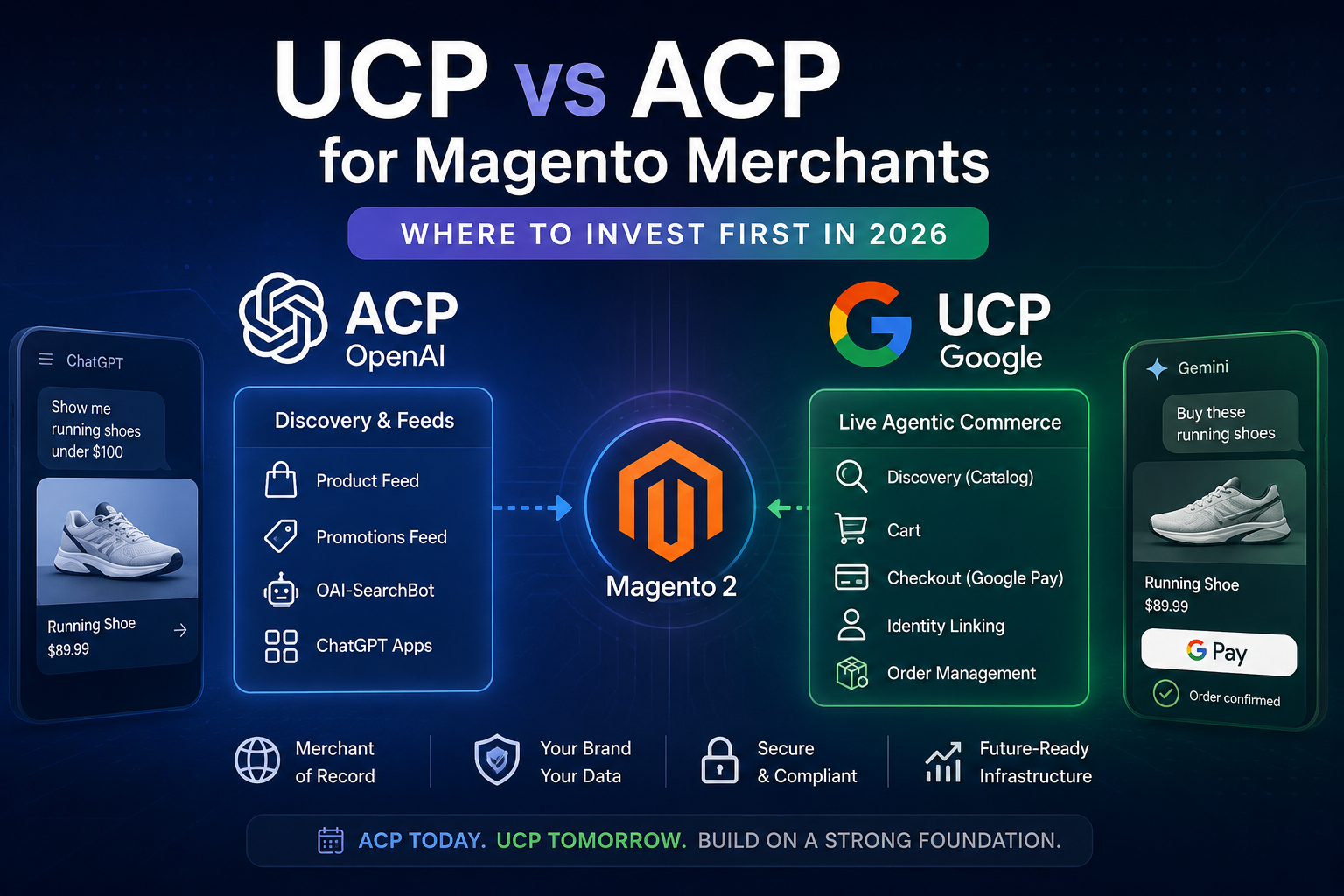
Key terms
ACP — Agentic Commerce Protocol
OpenAI’s open standard, co-developed with Stripe. Defines a product feed format (.jsonl.gz) and an optional checkout layer that was deprecated in March 2026. The feed surface remains active and is the primary discovery channel for ChatGPT Shopping.
UCP — Universal Commerce Protocol
Google’s open standard for agentic commerce, co-developed with Shopify, Stripe, Etsy, Walmart, Target, Wayfair, plus 20+ endorsers including Visa, Mastercard, and Adyen. Announced at NRF on January 11, 2026. Spec at ucp.dev. Includes live agentic checkout on Google surfaces.
Q: Is ACP dead?
No. OpenAI moved away from Instant Checkout, which was one ACP capability. The feed surface, OAI-SearchBot integration, and ChatGPT Apps platform are all active. ACP feeds have arguably become more important since March 2026, because they’re now the primary way to be discovered in ChatGPT Shopping.
Q: Is UCP a Google-only thing?
No. UCP is open source, vendor-agnostic, and surface-agnostic. Google built the first reference implementation (AI Mode in Google Search, Gemini), but the protocol is designed for any AI agent, retailer, or payment provider. Salesforce, Stripe, and Commerce Inc. have publicly committed to implementing UCP support.
Merchant of Record
The legal entity responsible for the sale — handling taxes, refunds, and customer relationships. Under both ACP and UCP, the Magento merchant remains the Merchant of Record. The protocols are communication layers, not marketplaces.
What is ACP (after March 2026)
ACP was co-developed by OpenAI and Stripe, open-sourced from day one, and launched in September 2025. The original promise: AI agents complete purchases natively inside ChatGPT.
That direction changed significantly on March 24, 2026. OpenAI announced it is moving away from a standalone Instant Checkout experience and is “allowing merchants to use their own checkout experiences while we focus our efforts on product discovery.” According to industry reporting, only a very small number of Shopify merchants ever went live with native ACP checkout before this shift.
What survived — and matters more than ever:
| ACP component | Status as of mid-2026 |
|---|---|
| Native in-ChatGPT checkout | Discontinued |
ACP product feed (.jsonl.gz) | Active and required |
| ACP promotions feed | Active |
| OAI-SearchBot crawler integration | Active |
| Stripe-as-payment-rail | Optional, used in Apps |
| ChatGPT Apps platform (Walmart-style) | Active, opt-in |
What ACP means for a Magento merchant today: ship an OpenAI-compatible product feed, register at chatgpt.com/merchants, get your products into ChatGPT’s discovery layer. The purchase itself happens on your Magento checkout — much like a regular referral, but the referrer is a chat conversation instead of a Google SERP.
Large merchants can additionally build a dedicated ChatGPT App. Walmart announced one in March 2026, with account linking, loyalty integration, and in-ChatGPT browsing of their catalog. The App platform is optional and best suited to merchants with engineering bandwidth to spare.
→ The Magento module that exposes the ACP feed: angeo/module-openai-product-feed-api
→ The static file generator: angeo/module-openai-product-feed
→ How to Register Your Magento 2 Store for ChatGPT Shopping
What is UCP
Unlike ACP today, UCP does include live agentic checkout. When a Gemini user says “buy these running shoes,” Gemini can take the purchase all the way through to confirmation — without the user ever opening your Magento storefront. You remain Merchant of Record, you receive the order through your normal Magento order pipeline, you fulfil and support as usual. UCP is the communication layer; your store is still the seller.
According to Google’s current rollout documentation, UCP defines five capabilities:
| Capability | What the agent can do |
|---|---|
| Discovery (Catalog) | Read real-time product data — variants, inventory, pricing |
| Cart | Add one or more items, including modifications |
| Checkout | Complete the purchase on Google surfaces using Google Pay |
| Identity linking | Apply loyalty pricing, member discounts, free shipping tiers |
| Order management | Fetch status, tracking, returns post-purchase |
Google states that discovery, identity linking and order management shipped at launch in January 2026; cart and full real-time catalog access were added in the March 2026 update.
UCP requires merchants to publish a manifest at https://yourstore.com/.well-known/ucp — a JSON document declaring which capabilities the store supports, plus several Merchant Center attributes (native_commerce, merchant_item_id, consumer_notice) on eligible products.
Q: Is UCP available outside the US in 2026?
Not at time of writing. Google has indicated global expansion through 2026 without committing to specific country dates. Until that lands, non-US Magento merchants should prioritise ACP.
Q: What about Amazon‘s agents — Rufus, Alexa+, Buy for Me?
Amazon has not joined ACP or UCP at time of writing. They appear to be building proprietary agents inside their own ecosystem. For a Magento merchant not on Amazon Marketplace, this isn’t directly actionable today — but the data hygiene work for ACP and UCP positions you well if Amazon ever opens their protocol.
ACP vs UCP — side by side
| Dimension | ACP (OpenAI) | UCP (Google) |
|---|---|---|
| Primary surface | ChatGPT, OAI-SearchBot, ChatGPT Apps | Gemini, AI Mode in Google Search, third-party agents |
| Checkout location | Merchant site (since Mar 2026) | Google surfaces (UCP) or merchant site (embedded mode) |
| Discovery format | .jsonl.gz product feed at registered endpoint | /.well-known/ucp manifest + Merchant Center feed |
| Payment rail | Whatever the merchant’s checkout uses | Google Pay (PayPal stated as coming) |
| Onboarding | chatgpt.com/merchants registration | Google Merchant Center early-access form |
| Geographic availability | Global | US only (mid-2026) |
| Magento native support | None — community modules only | None — community modules only |
| Merchant of Record | Merchant | Merchant |
| Customer data ownership | Merchant | Merchant |
| Maturity in mid-2026 | Mature on discovery; Apps growing | Early access, expanding |
The decision tree is simpler than it looks:
- If your store sells to US customers and you want to be on Gemini, you need UCP.
- If you want to be on ChatGPT (US or anywhere else), you need ACP feeds.
- If you sell internationally, ACP is your only protocol option this year — UCP isn’t there yet outside the US.
- If you do both, that’s normal. Most of the groundwork (product attributes, return policy, support contact, schema markup) is shared infrastructure.
How both protocols sit on top of Magento
At an architectural level, ACP and UCP plug into the same Magento components. The protocol surface differs; what’s underneath is the same store.
                  ChatGPT  /  Gemini  /  AI Mode
                            │
                ┌───────────┴───────────┐
                ▼                       ▼
         ACP product feed       UCP /.well-known/ucp
         (chatgpt.com/merchants) (manifest + capabilities)
                │                       │
                └───────────┬───────────┘
                            ▼
                  Magento 2 catalog + APIs
                  (products, inventory, pricing)
                            ▼
                Magento checkout + order pipeline
                  (quote, order, fulfilment)
Reading top to bottom: the AI surfaces are at the top, the protocol surfaces in the middle, and your Magento store at the bottom. Both protocols expose Magento data upward in different formats, but the source of truth — your catalog, your inventory, your prices, your checkout — never moves.
This is the practical reason ACP and UCP are sequential, not exclusive: most of the implementation work happens at the bottom two layers, and that work is reusable across both protocols.
The ecosystem is still moving
Before the roadmap, an honest caveat: this space is volatile. A few things to keep in mind:
- Specifications are evolving. Both protocols have shipped material updates since launch. The ACP shift in March 2026 (away from native checkout) and the UCP March 2026 update (cart + catalog) are unlikely to be the last.
- Rollout timelines can change. UCP’s path to general availability and global expansion is announced quarter-by-quarter. Treat any 2026-end timeline as directional.
- APIs are early-access. UCP merchant endpoints are gated and the surface contract can change before GA.
- Reporting layers don’t exist yet. Google has not shipped UCP-specific conversion reporting in Merchant Center; ACP attribution in GA4 is partial at best.
- Adoption data is sparse. Confident merchant counts and conversion benchmarks for either protocol should be read with caution. Few independent third-party datasets exist this early.
The implication for Magento merchants: optimise for reusable infrastructure — clean product data, consistent feeds, allowed AI bots, defined return policy, server-side order attribution — rather than for any single protocol’s current shape. That groundwork compounds no matter how ACP and UCP evolve from here.
The investment order for Magento 2 in mid-2026
Step 0 — Audit (this week)
Before any protocol work, know where you stand. Both UCP and ACP eligibility share the same foundation: AI bots allowed in robots.txt, complete Product JSON-LD, consistent pricing between site and feeds, defined return policy, working sitemap.
Skip this and you’ll spend weeks debugging “why doesn’t my feed validate” — when the actual problem is your offers.availability schema or a CDN rule blocking GPTBot.
composer require angeo/module-aeo-audit
bin/magento setup:upgrade
bin/magento cache:flush
bin/magento angeo:aeo:audit
You’ll get a weighted score across 20 signals and the exact composer require fix for each failure. The audit itself takes about 30 seconds.
Step 1 — ACP feed (this month)
ACP feeds are live, global, and stable. They route ChatGPT traffic to your Magento checkout — referral traffic with typically higher buying intent than a regular Google click, because the user has already expressed purchase intent in conversation.
composer require angeo/module-openai-product-feed-api
bin/magento setup:upgrade
bin/magento cache:flush
Then create a feed ID in admin, register at chatgpt.com/merchants, and your products start appearing in ChatGPT shopping results once OpenAI ingests the feed. Ingestion times vary.
For a slower-moving catalog (B2B, low SKU count), the static file version angeo/module-openai-product-feed works fine and avoids the runtime overhead of an API endpoint.
Step 2 — UCP manifest (when early access opens for you)
If your store sells in the US, apply to the Google Merchant Center UCP early-access program now. Once accepted, the technical work involves:
- Publishing a
/.well-known/ucpmanifest declaring which capabilities you support - Adding the
native_commerceattribute to eligible products in Merchant Center - Defining
return_policyandcustomer_supportat the account level - Mapping
merchant_item_idbetween Merchant Center and Magento product IDs
The angeo/module-ucp package publishes the roadmap and reserves the namespace for the Magento implementation we’re building against the GA release. Watch this space — the first alpha is targeted for Q3 2026, tracking Google’s UCP rollout. Timelines may shift with the protocol.
Step 3 — Cross-protocol consistency (continuous)
Once you have both surfaces live, the failure mode is no longer “we’re not on AI” — it’s data drift. The price in your Magento catalog is $89.99, the ACP feed says $87.50 (stale), the Merchant Center says $89.99, and the on-page JSON-LD says $90.00 because of a frontend caching bug. AI agents notice these inconsistencies and reduce recommendation confidence.
This is where the audit tool earns its place as a recurring check, not a one-off:
# Daily consistency check via cron
bin/magento angeo:aeo:audit --format=json --fail-on=80 \
  | tee /var/log/aeo-audit-$(date +%F).json
Set --fail-on=80 so any drop below 80% pages your team. Catalog price/inventory mismatches are a common drift source.
Common misconceptions
“OpenAI killed ACP.” No. OpenAI moved away from Instant Checkout, which was one ACP capability. The protocol — feeds, agentic discovery, the Stripe co-development — is still alive, and the feed surface has arguably become more important because it’s now the primary way to be discovered in ChatGPT Shopping.
“UCP is just for big merchants.” Google has stated it is expanding UCP onboarding through Merchant Center to retailers of all sizes during 2026. The technical bar is real but not enterprise-only. A Magento store with a clean catalog, working schema, and a defined return policy is most of the way there.
“We can wait — agentic commerce isn’t proven yet.” This is a fair concern, and the volume data so far is modest. The counter-argument is that the underlying work (clean schema, accurate feeds, defined policies) is permanent infrastructure that pays back regardless of which protocols ultimately win.
“Hyvä breaks AI-readiness.” Hyvä does change how JSON-LD ships (PHTML-rendered rather than via XML layout in some themes). It does not inherently break ACP or UCP — both rely on backend data, not the frontend theme. There are Hyvä-specific gotchas (offers.availability, the data-component attribute) covered in Product Schema FAIL in Magento 2 AEO Audit — How to Fix It.
What this means for your roadmap
If you take one thing from this post: ACP and UCP look more like sequential investments than an either/or decision. A reasonable 2026 Magento agentic-commerce roadmap might look like this:
| Quarter | Action |
|---|---|
| Q2 2026 | Run angeo:aeo:audit. Fix every fail. Ship ACP product feed. Register at chatgpt.com/merchants. |
| Q3 2026 | Apply for UCP early access. Prepare /.well-known/ucp manifest. Audit Merchant Center for native_commerce eligibility. |
| Q4 2026 | Wire UCP cart + checkout in sandbox (if access granted). Build server-side attribution for agentic orders. Iterate on data consistency. |
| 2027 | UCP general availability (timing per Google’s announcements). Cross-protocol monitoring. Hyvä, multi-store, multi-language coverage. |
Each step builds on the previous one. None of it is wasted if the agentic-commerce landscape shifts again — the underlying work survives any specific protocol change.
Frequently asked questions
Can Magento merchants implement ACP and UCP without Adobe Commerce?
Yes. Both ACP and UCP are fully compatible with Magento Open Source — Adobe Commerce is not a requirement. The implementation work is almost entirely at the feed, manifest, and API layer, all of which are exposed by the standard Magento 2 framework (Magento_Catalog, Magento_Quote, Magento_Sales, Web API). The differences between Open Source and Adobe Commerce — staging, page builder, B2B features — are not blockers for either protocol. Most ACP/UCP-readiness fixes (robots.txt, JSON-LD, return policy, structured product attributes) are configuration-level, not platform-tier-level. Adobe Commerce Cloud does deploy modules the same way, so a community module that ships ACP or UCP support works on both editions.
Will ACP and UCP eventually merge?
Unlikely as protocols — they are designed around different agent ecosystems (OpenAI vs Google). What is more likely is convergence at the data layer — product attributes, return policy, support contact, identity linking. Google’s UCP is documented as compatible with MCP and A2A, which OpenAI also uses, so interop at the data layer is more probable than full protocol merger.
Do I need both, or can I pick one?
If your traffic is overwhelmingly from one AI surface, you can start with one. Otherwise: ACP first (global, mature), UCP second (US, growing). The groundwork overlaps significantly.
Does Adobe Commerce Cloud support UCP natively?
No native support as of mid-2026. The implementation requirements are the same as Magento Open Source — a community module that handles the manifest, capability endpoints, and Merchant Center attribute mapping.
What’s the minimum Magento version?
Magento 2.4.7 or higher is generally recommended. Earlier 2.4.x versions have known REST API authentication issues that can interfere with both ACP and UCP endpoint implementations.
Does Hyvä theme work with ACP and UCP?
Yes. Both protocols operate on backend data — catalog, inventory, prices, orders — not on the frontend rendering layer. Hyvä’s PHTML-rendered JSON-LD requires explicit configuration for offers.availability, but this is the same fix required for Magento 2 AEO in general.
Run the audit, then pick your protocol
composer require angeo/module-aeo-audit
bin/magento setup:upgrade && bin/magento cache:flush
bin/magento angeo:aeo:audit
Free, open-source, MIT-licensed. Tells you in about 30 seconds where your Magento 2 store stands across both ACP and UCP signals, with the exact next command to run for each failure.
Prefer a human read? Book a free 30-minute AEO audit review. We’ll walk through your score together and show you exactly which blockers prevent ACP and UCP eligibility — most stores surface a schema or Merchant Center issue within the first ten minutes that, once fixed, unlocks the rest of the work.
Install CLI Audit → Free Web Self-Assessment →