Update, October 2026. Since this comparison was written, UCP moved to spec 2026-08-25: signing keys now live in a top-level keys[] array, schema is required on capabilities, and platforms check authority binding. angeo/module-ucp 2.x targets 2026-08-25, and catalog.search and catalog.lookup now ship in angeo/module-ucp-catalog. Cart and checkout are still not part of the angeo UCP modules.
The angeo rows below are updated. The other three modules are described as of June 2026 – check their repositories for newer releases and spec support before you choose.
What is a Magento 2 UCP module?
A Magento 2 UCP module adds support for the Universal Commerce Protocol (UCP) — an open protocol that lets agentic commerce systems discover merchants, read catalog data, build carts, and complete purchases through standardized APIs. Magento 2 has no built-in UCP support, so the capability comes from a module. As of June 2026 there are four publicly available options: angeo/module-ucp (discovery-only, MIT), gtstudio/module-ucp (full checkout, BSL 1.1), mahesh-rajawat/module-agentic-ucp (broad coverage, MIT), and spyrosoft/magento2-google-ucp (proof of concept, Apache-2.0).
UCP is an actively evolving protocol — module capabilities, naming, and the spec itself change frequently. This comparison reflects the state of the available Magento 2 modules and UCP spec version 2026-04-08 as of June 2026, based on each module’s public repository and Packagist listing. We update this guide when the landscape shifts.
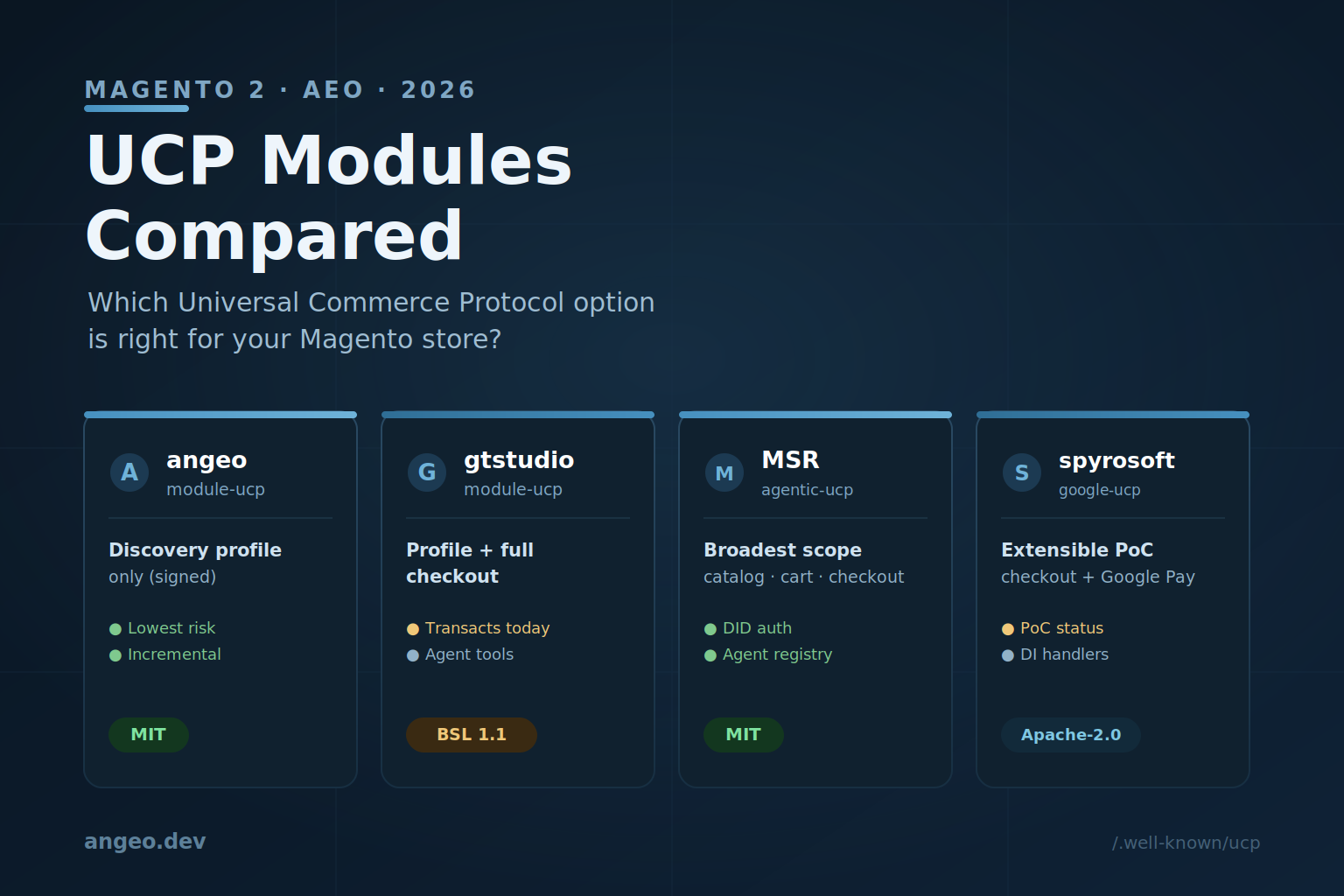
Four publicly available UCP modules now exist for Magento 2 — and they solve very different problems.
Universal Commerce Protocol (UCP) is an open protocol that lets agentic commerce systems discover merchants, access catalog information, build carts, and complete purchases through standardized APIs. For Magento 2, that capability is not built in — it comes from a module. This guide compares the four publicly available options.
TL;DR — 2 minute version
- Magento has no built-in UCP support. To be discoverable by Google-powered shopping surfaces that implement UCP (including AI Mode and Gemini), you need a module — or you build it yourself.
- There are now at least four publicly available Magento 2 UCP modules, plus middleware/SaaS bridges. They are not interchangeable — some only publish a discovery profile, others implement full agent-driven checkout. Licenses differ too (MIT, Apache-2.0, and one Business Source License) — check before you adopt.
- The single biggest decision: do you need profile-only discovery (low risk, fast to install) or functional checkout endpoints (more surface area, more to maintain while the spec is unstable)?
- Don’t install any of them until your AEO foundations are in place. A UCP profile on a store with blocked crawlers and missing schema is a door with nothing behind it.
- This guide compares the four modules on scope, license, risk, and who each one is for — so you pick once instead of twice.
First: do you even need a UCP module yet?
Before comparing modules, answer this honestly. UCP makes your store discoverable to shopping agents that support the protocol. It does not guarantee recommendations, and UCP-powered shopping features are rolling out gradually, beginning with the US market. International expansion has been announced, but timelines vary by region.
So the case for installing a module now is not “instant sales.” It’s two things:
- Early-mover positioning. Public Magento UCP implementations remain relatively uncommon. Establishing a spec-compliant profile now means you’re indexed and ready when your market’s agent-shopping surfaces go live, rather than starting from scratch afterward.
- It’s cheap at the discovery layer. Publishing a
/.well-known/ucpprofile is, on a compatible Magento environment, a short job rather than a multi-day project.
The case against rushing: the checkout side of the spec is still moving. Implementing full agent-driven checkout today means maintaining endpoints against a moving target. That trade-off is exactly what separates the modules below.
If you’re not sure where you stand, the honest first step isn’t a UCP module at all — it’s an AEO audit, because UCP sits on top of the foundational signals (robots.txt access, JSON-LD with offers.availability, llms.txt, product feed). More on that at the end.
How UCP modules differ: the two layers that matter
Every UCP module addresses some combination of two distinct layers. Understanding this split is the whole game.
Layer 1 — Discovery (the profile). Your store publishes a signed file at yourstore.com/.well-known/ucp that advertises what it can do — catalog, cart, checkout, order, identity linking. Shopping agents read this “menu” first. Publishing it is low-risk: it’s a static, signed declaration, and you only advertise the capabilities you actually support.
Layer 2 — Execution (the endpoints). The actual REST endpoints an agent calls to search your catalog, build a cart, and drive a checkout session to completion. This is where the real work — and the real maintenance risk — lives, because these endpoints must track the evolving spec and map cleanly onto Magento’s quote/order model.
A module that does only Layer 1 makes you findable. A module that does Layer 1 + Layer 2 makes you transactable. Neither is “better” — they suit different timelines and risk appetites.
The four Magento 2 UCP modules, compared
Here’s the current landscape, verified against each module’s Packagist listing and repository in June 2026. All run on your own Magento instance (no third-party SaaS in the loop), but their scope and licensing differ sharply.
| Module | License | Latest (date) | Production readiness | Scope | Best for |
|---|---|---|---|---|---|
angeo/module-ucp |
MIT | 2.1.0+ (Sep 2026) | Profile + catalog (with ucp-catalog) | Discovery profile only. Serves /.well-known/ucp at spec 2026-08-25 with ECDSA P-256 signing, per-store-view capability toggles. Catalog search and lookup ship in angeo/module-ucp-catalog. Cart and checkout are not implemented. |
Stores wanting early, low-risk presence and an incremental path |
gtstudio/module-ucp |
BSL 1.1 | 1.0.0 (Mar 2026) | Production checkout | Discovery profile + five checkout session endpoints (create/get/update/complete/cancel), Magento quote-state mapping, registered shopping-agent tools. | Stores that want functional agent checkout today |
mahesh-rajawat/module-agentic-ucp (+ -checkout companion) |
MIT | 1.0.1 (Apr 2026) | Experimental / broad coverage | Base module: agent discovery, DID authentication, policy enforcement, admin agent registry. Companion adds catalog/cart/checkout/order/tracking REST endpoints. | Stores wanting runtime agent registration and policy control |
spyrosoft/magento2-google-ucp |
Apache-2.0 | 1.1.0 (Mar 2026) | Proof of concept | Checkout/fulfillment/order capabilities, Google Pay via Przelewy24, DI-based extensibility. Catalog and cart are roadmap, not yet implemented. | Teams evaluating/extending UCP with custom payment handlers |
A few things worth pulling out of that table:
angeo/module-ucp is deliberately the most conservative. It ships the discovery profile first and adds endpoints as the spec stabilises. The philosophy: don’t build functional checkout against a moving target until the target slows down. Lowest maintenance burden, lowest risk — but you are findable, not yet transactable. MIT-licensed; requires Magento 2.4.x (ucp-catalog: 2.4.6+), PHP 8.2+ and the OpenSSL extension for ECDSA signing.
gtstudio/module-ucp goes furthest on checkout in a single package. It implements the five UCP checkout session endpoints and maps Magento quote state (incomplete → ready_for_complete → completed | cancelled) directly onto UCP session state, and even seeds a ucp_checkout agent with a UCP-aware system prompt. If you want an agent to actually complete a purchase against your store today, this is the most direct route. Two trade-offs: you’re maintaining checkout logic against an unstable spec, and it’s licensed under the Business Source License 1.1 — which is source-available, not OSI open-source. Read the BSL terms (usage restrictions, delayed open-source conversion date) before adopting it commercially.
mahesh-rajawat/MSR splits identity from checkout across a base + companion module, both MIT. Its differentiator is runtime governance: no hardcoded agents — real agent DIDs are registered in the admin panel, with policy enforcement and per-agent isolated guest carts. If your concern is which agents you let transact and under what rules, this architecture leans into that.
spyrosoft/magento2-google-ucp is openly a PoC (Apache-2.0). Its value is extensibility — clean DI surfaces for plugging in custom payment handlers, validators, and response builders. Two caveats: it currently implements checkout, fulfillment, and order capabilities but not catalog or cart (both are on its roadmap), and in its current release Google Pay is powered by a hard dependency on the Przelewy24 payment module — relevant if that PSP doesn’t fit your market.
Capability matrix (June 2026 snapshot)
A quick visual of what each module actually implements today (not roadmap). Verified against current repositories, June 2026.
| Capability | angeo | gtstudio | MSR | spyrosoft |
|---|---|---|---|---|
Discovery profile (/.well-known/ucp) |
✓ | ✓ | ✓ | ✓ |
| Checkout session endpoints | ✗ (roadmap) | ✓ | ✓ | ✓ |
| Catalog | ✗ (roadmap) | ✗ | ✓ | ✗ (roadmap) |
| Cart | ✗ (roadmap) | ✗ | ✓ | ✗ (roadmap) |
| Order / fulfillment | ✗ (roadmap) | partial | ✓ | ✓ |
| Agent registry / DID auth | ✗ | ✗ | ✓ | ✗ |
| Signed profile (ECDSA P-256) | ✓ | — | — | — |
| License | MIT | BSL 1.1 | MIT | Apache-2.0 |
Capabilities change rapidly as the UCP specification evolves. Treat this matrix as a point-in-time comparison rather than a permanent feature list — “partial” means implemented as part of the checkout session lifecycle rather than as a standalone capability. Always confirm against the module’s current release before relying on any single cell.
A decision path, not a winner
There’s no single “best” module, because the right choice is a function of your timeline and your tolerance for spec churn. Walk this:
Are your AEO foundations done? (robots.txt allows AI bots, Product JSON-LD with offers.availability, llms.txt, product feed.) → If no, stop. Fix those first. UCP adds nothing on top of a store AI can’t read. Run the AEO audit.
Do you need functional agent checkout this quarter?
– No — you want presence and readiness → angeo/module-ucp. Profile plus catalog endpoints (with angeo/module-ucp-catalog), fast to install on a compatible environment, minimal maintenance, incremental upgrade path as the spec settles, MIT-licensed.
– Yes — agents must be able to transact now → gtstudio/module-ucp for the most complete single-package checkout (mind the BSL license), or mahesh-rajawat/MSR if you want MIT licensing plus runtime agent registration and policy control.
Do you have engineering capacity and want to own the implementation? → spyrosoft/magento2-google-ucp as an Apache-2.0 extensible PoC base — checking the Przelewy24 payment dependency fits your stack.
A pragmatic combined play many stores will consider: ship a low-risk discovery profile today (e.g. angeo/module-ucp), and prototype checkout separately in staging with one of the full-checkout modules — so your public surface stays stable while you experiment with the volatile part out of production.
What none of these modules do for you
A UCP module gets your store onto the protocol. It does not make an agentic commerce system choose you. That depends on factors no module controls:
- Catalog quality — complete, real product data, not supplier boilerplate.
- Pricing competitiveness — agents compare across merchants when they build recommendations.
- Review signals —
aggregateRatingin your schema affects recommendation confidence. - Entity authority — how well-known your brand is across the web.
- Schema completeness — JSON-LD with
offers.availability, the field default Magento most often omits. - Feed freshness — stale prices or wrong stock erode agent trust fast.
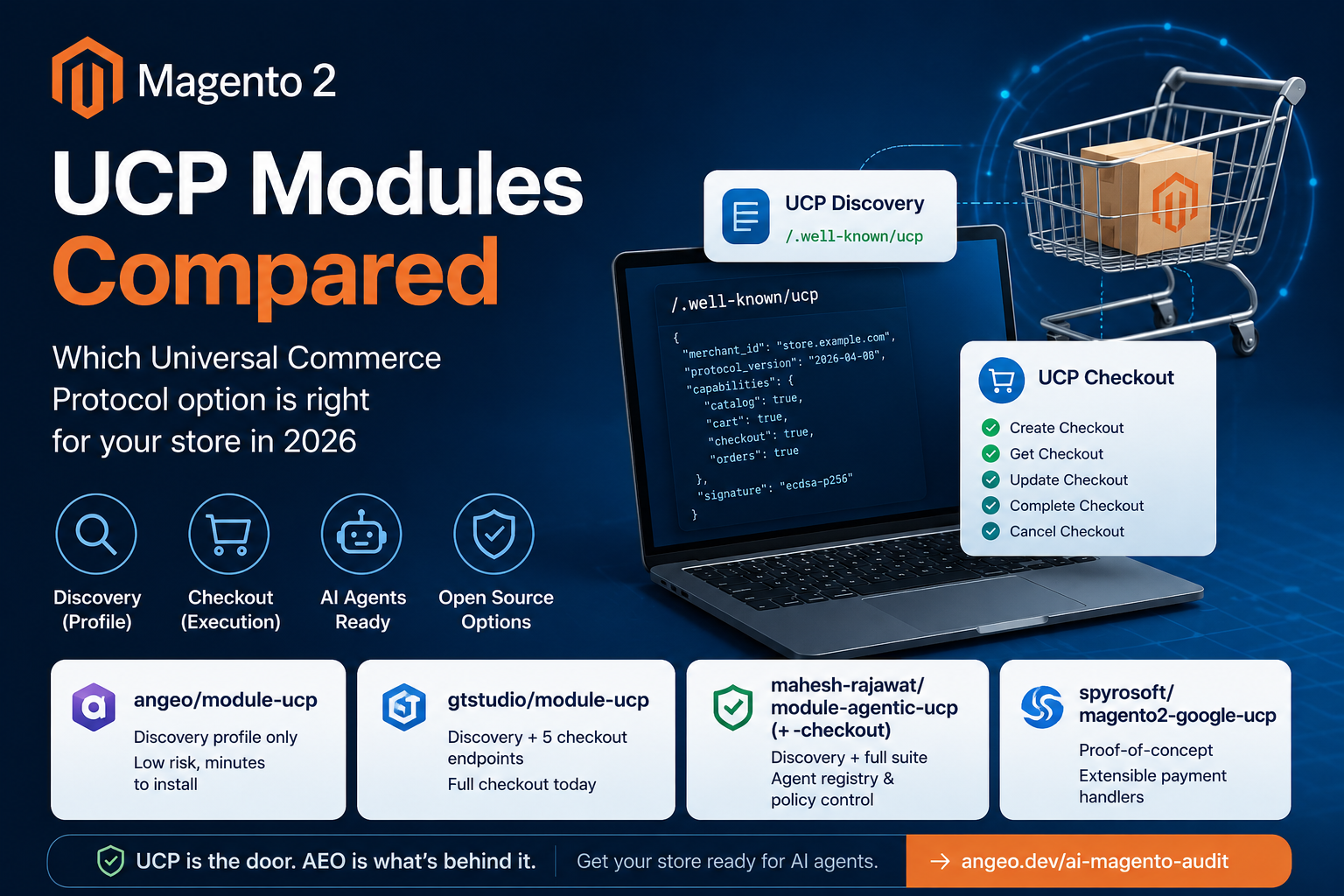
This is the recurring lesson: UCP is the door; AEO is the inventory behind it. Installing any module above before the foundations are solid is effort spent on a storefront with empty shelves.
Where to start
- Audit first. Run the free AEO self-assessment — it checks the foundational signals UCP builds on, and most Magento stores have gaps here.
- Fix foundations. Work through the Magento 2 AEO Guide: robots.txt, llms.txt, Product schema, product feed.
- Then pick a UCP module using the decision path above — profile-only for low-risk readiness, full checkout if you need agents transacting now.
- If you also sell into ChatGPT, remember UCP only covers Google’s surfaces. ChatGPT uses ACP — see ACP vs UCP for Magento 2 for the dual-protocol strategy (the foundations overlap, so most of the work is shared).
Not sure if your store is even ready for shopping agents?
The audit checks all the AEO signals UCP depends on — including the foundations behind the door. 30 seconds, no installation.
Official module repositories
For verification and source review, the four modules compared here:
angeo/module-ucp— Packagist · GitHub (MIT)gtstudio/module-ucp— Packagist · GitHub (BSL 1.1)mahesh-rajawat/module-agentic-ucp— Packagist · GitHub (MIT) — plus the-checkoutcompanionspyrosoft/magento2-google-ucp— Packagist · GitHub (Apache-2.0)
Related guides
- What Is UCP? A Store Owner’s Guide →
- UCP Readiness Checklist for Magento 2: 10 Steps →
- ACP vs UCP for Magento 2: Which to Implement First →
- Magento 2 AEO Guide 2026 →
FAQ
Which Magento UCP module should I install?
It depends on whether you need discovery only or functional checkout. For low-risk early presence, a profile-only module like angeo/module-ucp (MIT) installs quickly and has minimal maintenance. For agents that must complete purchases today, a full-checkout module like gtstudio/module-ucp (BSL 1.1) or mahesh-rajawat/MSR (MIT) goes further — at the cost of maintaining endpoints against an evolving spec. Always fix your AEO foundations first.
Are these UCP modules free / open-source?
Licensing varies. angeo/module-ucp and mahesh-rajawat/MSR are MIT. spyrosoft/magento2-google-ucp is Apache-2.0. gtstudio/module-ucp is Business Source License 1.1 — source-available with usage restrictions, not OSI open-source. The UCP protocol itself is published under Apache 2.0, and Google has not announced any merchant participation fees for UCP at the time of writing. Your cost is implementation and maintenance time.
Can I install a UCP module if I’m not in the US? Yes — publishing a profile makes you ready before your market’s agent-shopping surfaces go live. UCP-powered features began rolling out in the US, with international expansion announced but timelines varying by region. Being already-correct when your market activates beats scrambling afterward.
Do I still need ACP (ChatGPT) if I implement UCP? They cover different platforms — UCP for Google’s shopping surfaces, ACP for ChatGPT. If both audiences matter to you, implement both; the underlying product-data and schema foundations overlap heavily.
What Magento version do these need? Most require Magento 2.4.x and PHP 8.1–8.4 depending on the module (the angeo module needs 2.4.7+, PHP 8.2+, and OpenSSL for ECDSA signing). Spyrosoft additionally requires the Przelewy24 payment module in its current release. Check each module’s Packagist page for exact constraints before installing.
Can multiple UCP modules be installed together?
Usually no. Most modules expose the same /.well-known/ucp endpoint and overlapping REST routes, so running two implementations simultaneously can create routing conflicts and an inconsistent advertised profile. Choose one implementation per store. If you want to evaluate more than one, do it in separate environments (for example, a discovery-only module in production and a full-checkout module in staging) rather than side by side on the same instance.
Does installing a UCP module guarantee my products get recommended? No. UCP makes you discoverable — it’s a prerequisite, not a guarantee. Recommendation depends on catalog quality, pricing, reviews, brand authority, schema completeness, and fulfilment reliability. The module opens the door; your AEO foundations determine whether the agent walks through it.
We are the maintainers of angeo/module-ucp. This comparison is based on publicly available documentation and repository analysis as of June 2026, and we’ve tried to represent the alternatives fairly on their own merits — gtstudio/module-ucp genuinely goes further on checkout today, and mahesh-rajawat/MSR offers broader capability coverage under an MIT license, both of which are the right call for some stores. The UCP spec moves frequently; verify current module versions, licenses, and the live spec at ucp.dev before you implement.