In the competitive world of eCommerce, attracting and converting potential customers is more challenging than ever. If you run a Magento 2 store, integrating LLMs (Large Language Models) with TXT/JSONL-based content workflows can significantly improve your lead generation, SEO visibility, and customer engagement.
You can find a ready-to-use LLMs.txt Magento module on Packagist.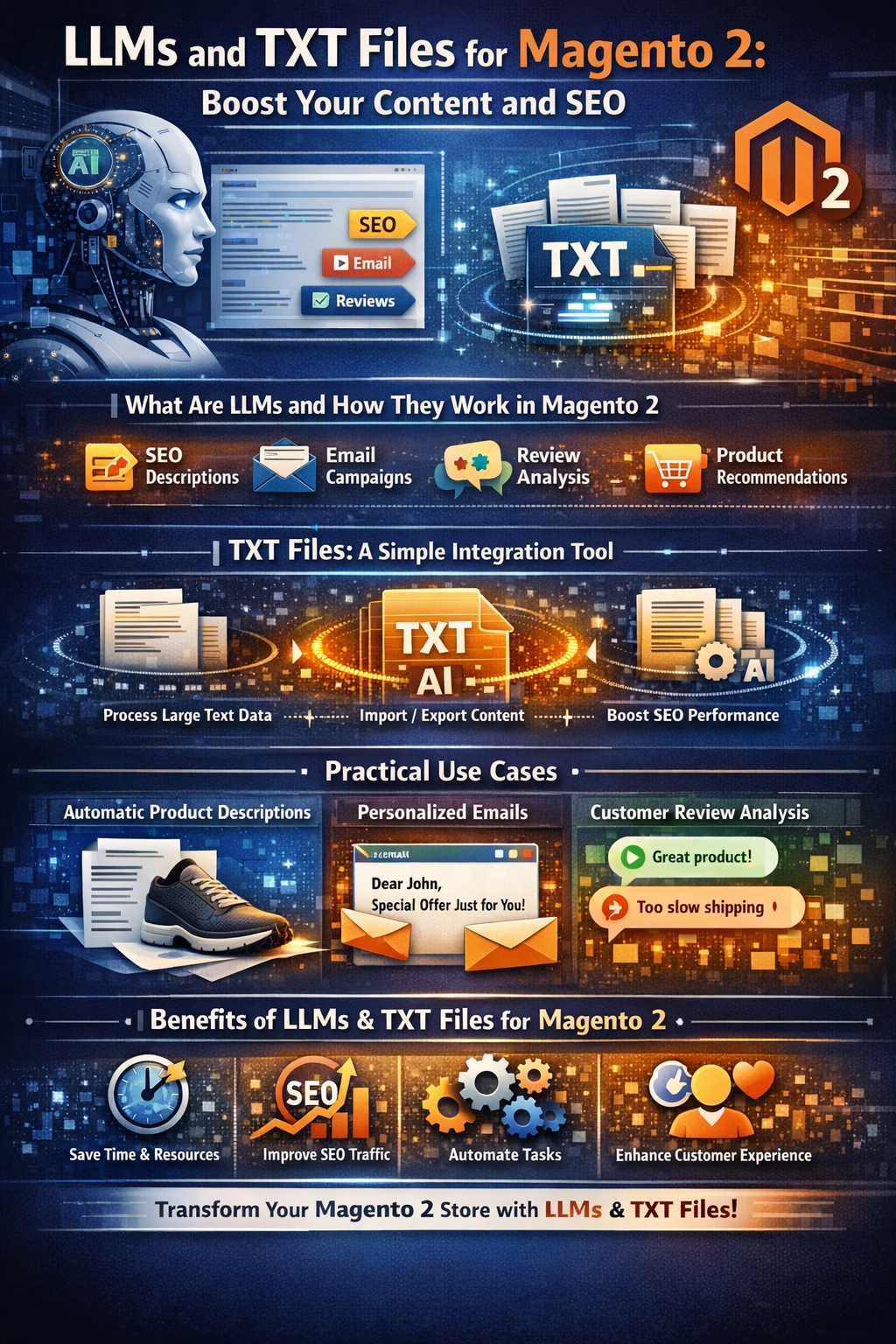
Why Lead Generation in eCommerce Requires Smarter Content
Modern customers expect personalized experiences, fast answers, and relevant product recommendations. Search engines reward websites that publish unique, high-quality, and optimized content.
By combining LLMs with structured JSONL/TXT data exported from Magento 2, stores can automate content production while improving organic traffic and conversion rates.
How LLMs Drive More Potential Clients to Your Magento 2 Store
- SEO-optimized product descriptions that rank higher in search engines
- Automated blog and landing page content targeting commercial search intent
- Personalized email marketing campaigns
- Customer behavior analysis for better targeting
Instead of manually writing hundreds of product descriptions, LLMs can generate keyword-rich, conversion-focused content in minutes using JSONL feeds exported from your Magento 2 catalog.
Why JSONL/TXT Files Make Automation Scalable
JSONL files provide a simple and universal way to store and process large volumes of structured content data. In Magento 2, these files can be used to:
- Export product specifications and metadata
- Store SEO templates and product descriptions
- Feed structured prompts into AI models for content generation
- Process reviews or categories in bulk
This makes your content pipeline efficient, scalable, and ready for growth.
Practical Lead Generation Strategies Using AI in Magento 2
1. Generate SEO Landing Pages at Scale
Using your JSONL product feed, you can automatically generate optimized landing pages for high-intent keywords like “buy online”, “best price”, or “fast delivery”. This increases visibility and attracts ready-to-buy visitors.
2. Automate Email Funnels
Feed structured product and category data into AI models to generate personalized abandoned cart emails, product recommendations, and promotional offers that convert visitors into paying customers.
3. Analyze Customer Reviews and Product Data
By ingesting product, category, and brand JSONL files into an AI system, you can identify common objections, optimize descriptions, and improve messaging — boosting trust and conversions.
Example JSONL Feed for AI Ingestion
Here’s a sample product entry from your Magento 2 AI feed:
{
  "id": "SKU-123",
  "type": "product",
  "store": "default",
  "locale": "en_US",
  "title": "Apple iPhone 14 Pro",
  "content": "Experience the latest iPhone 14 Pro with stunning display, advanced camera, and unmatched performance.",
  "metadata": {
    "price": 999,
    "currency": "USD",
    "categories": ["Electronics", "Phones"],
    "brand": "Apple",
    "image": "https://example.com/media/catalog/product/i/m/image.jpg",
    "last_updated": "2026-03-01 12:00:00",
    "stock": true
  }
}
LLM Workflow with Magento JSONL
The process works like this:
- Step 1: Magento 2 generates AI feeds (`ai_feed_default.jsonl`, `ai_categories_default.jsonl`, `ai_brands_default.jsonl`).
- Step 2: The JSONL files are ingested into an AI system (OpenAI, LangChain, or Claude).
- Step 3: LLM processes the data to generate product descriptions, landing pages, email content, or reports.
- Step 4: Generated content is automatically deployed to Magento 2 or marketing systems.
AI Query Example
You can query your AI knowledge base directly. Example:
User Query → AI searches JSONL feed → Outputs relevant products:
Query: "List all Apple smartphones under $1000 in stock"
Result:
1. Apple iPhone 13 - $799
2. Apple iPhone SE - $429
Business Benefits for eCommerce Owners
- Automated SEO-optimized product content
- Increased organic traffic and visibility
- Reduced content production costs
- Faster campaign execution without growing your team
- Actionable insights from customer reviews and product performance
Conclusion: Turn AI into a Client Acquisition Engine
For Magento 2 store owners, combining LLMs with structured JSONL/TXT feeds is a strategic growth decision. It helps attract qualified traffic, engage potential customers, and convert them into loyal buyers automatically.
If you have any questions, feel free to contact us at info@angeo.dev.

2 Comments
Anton · March 9, 2026 at 8:37 pm
What exactly does the LLMs.txt Magento module do? Does it expose data to AI models or just prepare structured feeds?”
Ievgenii Gryshkun · March 10, 2026 at 6:00 am
The LLMs.txt Magento module generates a structured llms.txt file that helps AI systems and large language models understand which parts of your website are important. It does not expose private data or send information directly to AI models.
Instead, the module simply creates a public file on your website (similar to robots.txt or sitemap.xml) that lists key pages and content in a format that AI crawlers can easily interpret.
This helps improve how AI systems discover and reference your content when generating answers or summaries.
Additionally, the module can generate a JSONL file (.jsonl – JSON Lines format). A JSONL file contains structured records where each line is a separate JSON object. This format is commonly used for AI data processing and datasets. The generated JSONL file can also be imported into platforms such as OpenAI to be used as a dataset for model training, fine-tuning, or other AI workflows.
In a nutshell:
LLMs.txt → tells AI crawlers which pages are important
JSONL file → provides structured content data that AI systems can process efficiently
The module does not send data to AI models, it only prepares structured files that can be publicly accessed by crawlers.