Tools and platform behavior change — verify current versions and Google guidelines as you work through this.
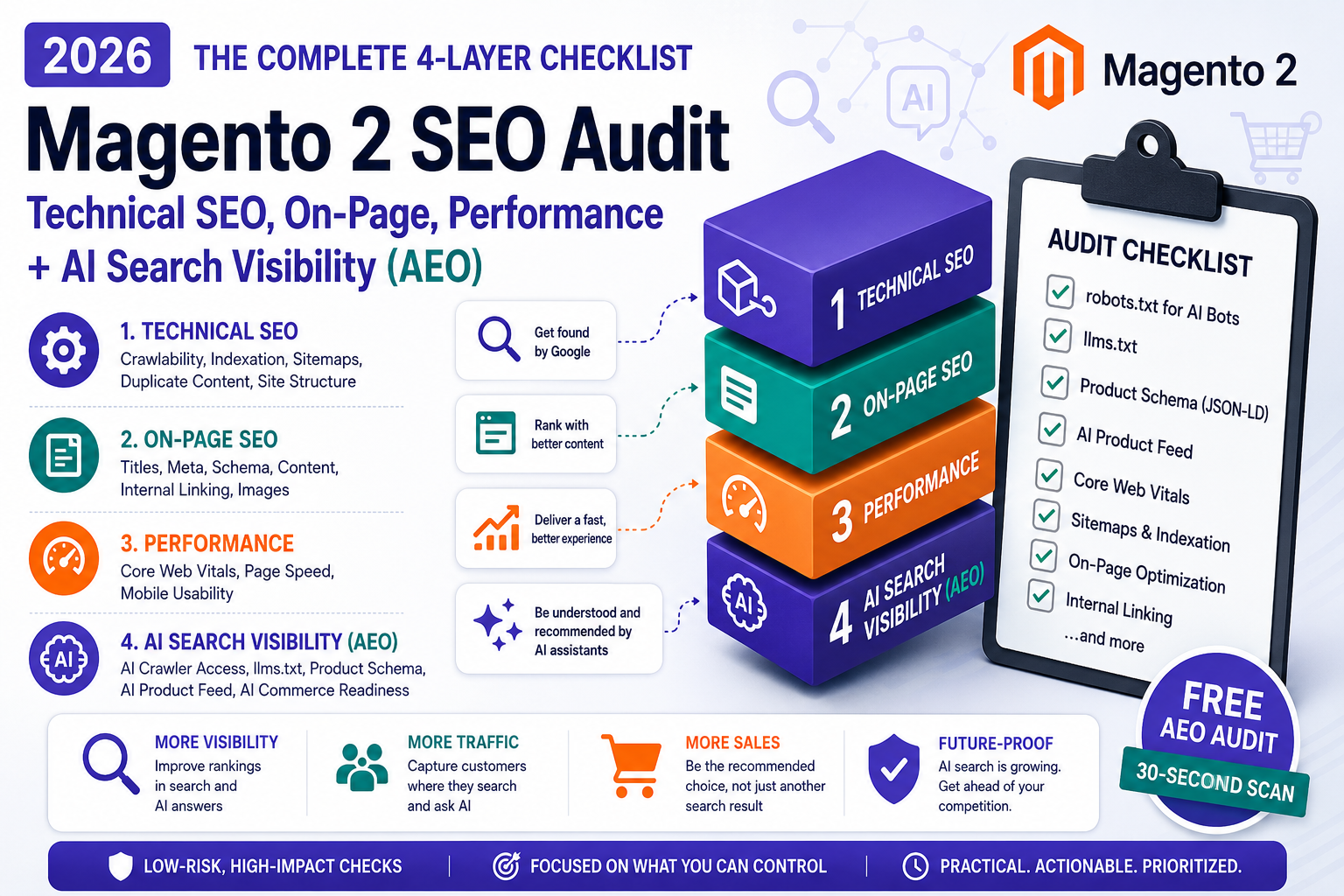
TL;DR — what a 2026 Magento audit covers
- One useful way to structure a Magento audit in 2026 is across four practical layers: technical SEO, on-page SEO, performance, and — new in 2026 — AI search visibility (AEO)
- Most audit checklists stop at traditional SEO. That leaves a growing blind spot: whether AI assistants can find and recommend your store
- Traditional SEO tools (Screaming Frog, Lighthouse, Search Console) cover the first three layers well
- AI search visibility needs its own checks: robots.txt for AI crawlers, llms.txt, Product schema completeness, structured product feeds (where supported)
- This guide gives a full checklist for both — and a free tool for the AEO layer
If you run a Magento 2 or Adobe Commerce store, an SEO audit used to mean one thing: check whether Google can crawl, index, and rank your pages. That is still essential — but in 2026, it is no longer the complete picture.
A growing share of product discovery now happens inside AI assistants — ChatGPT, Perplexity, Gemini — where customers ask questions and receive recommendations without visiting a search results page. A store can pass every traditional SEO check and still be invisible to these systems.
This guide covers the full 2026 audit: the technical and on-page SEO checks every Magento store needs, plus the AI search visibility layer most checklists miss.
A practical four-layer framework for Magento audits in 2026
In this guide, we break a Magento audit into four practical layers. This is a structuring framework, not an industry standard — but separating these concerns makes findings clearer and harder to miss.
| Layer | What it checks | Primary tools |
|---|---|---|
| 1. Technical SEO | Crawlability, indexation, sitemaps, duplicate content, URL structure | Search Console, Screaming Frog |
| 2. On-page SEO | Titles, meta, headings, schema, internal linking, images | Screaming Frog, Rich Results Test |
| 3. Performance | Core Web Vitals, page speed, mobile usability | Lighthouse, PageSpeed Insights |
| 4. AI search visibility (AEO) | AI crawler access, llms.txt, Product schema for AI, structured product feeds and merchant data sources (where supported) | AEO audit tools |
Layers 1–3 are well-covered by established tools and checklists. Layer 4 is newer, less understood, and often receives less attention than traditional SEO areas.
Layer 1: Technical SEO audit
Technical SEO ensures Google can crawl and index your store correctly. For Magento 2, the recurring problem areas are predictable.
Crawlability & indexation
- robots.txt allows Googlebot and does not accidentally block key pages
- XML sitemap is current, submitted in Search Console, and excludes noindex URLs
- No critical pages returning 404 or 5xx — check Search Console Coverage report
- Faceted navigation (layered nav filters) is not generating thousands of crawlable parameter URLs
- Canonical tags are correct on category, product, and paginated pages
Site structure
- Category hierarchy no deeper than 3 levels
- SEO-friendly URLs without unnecessary parameters (Magento: Stores → Config → Web → URL options)
- 301 redirects in place after any URL changes — preserve link equity
- No redirect chains (301 → 301 → 200 wastes crawl budget)
- Breadcrumbs present and marked up with BreadcrumbList schema
Layer 2: On-page SEO audit
Metadata & content
- Unique title tags on every indexable page (no “Default Title” or duplicate category titles)
- Meta descriptions present and unique on key pages
- One H1 per page, descriptive and keyword-relevant
- Product descriptions are original — not manufacturer/supplier copy duplicated across the web
- Category pages have real descriptive content, not just a product grid
- Image filenames and alt text are descriptive (e.g.
nike-pegasus-41-blue.jpg, notIMG_4821.jpg)
Structured data (schema)
- Product schema (JSON-LD) present with name, price, currency, and availability
- Organization schema on the homepage
- BreadcrumbList schema on category and product pages
- FAQPage schema where you have FAQ content
- Schema validates in Google’s Rich Results Test with no errors
offers.availability. Both matter more in 2026 because JSON-LD is generally easier for search engines and automated systems to parse consistently than embedded microdata.
Internal linking
- Important products are reachable within 3 clicks of the homepage
- Related products and cross-sells create internal link paths
- No orphan pages (indexable pages with zero internal links)
- Blog/content links to relevant category and product pages
Layer 3: Performance & Core Web Vitals
In 2026, mobile is the primary index Google uses, and Core Web Vitals are a confirmed ranking factor. Magento 2 stores — especially on the default Luma theme — frequently fail here.
- Largest Contentful Paint (LCP) under 2.5s on mobile
- Cumulative Layout Shift (CLS) under 0.1
- Interaction to Next Paint (INP) under 200ms
- Images served in modern formats (WebP/AVIF) and lazy-loaded below the fold
- Full-page cache (Varnish) enabled and working
- JavaScript and CSS minified and merged; render-blocking resources minimized
- Production mode enabled (
bin/magento deploy:mode:set production)
Layer 4: AI search visibility (AEO) — the layer most audits miss
Here is what nearly every Magento SEO audit checklist published in 2026 still leaves out: whether AI systems can find, understand, and recommend your store.
This matters because the behaviour has already shifted. When a customer asks ChatGPT “recommend a [your category] store” or asks Perplexity to compare products, your traditional SEO ranking may not directly apply — these systems appear to draw on different signals, though their exact selection logic is not publicly documented. A store ranked highly on Google can still be absent from AI recommendations.
This is AEO — Answer Engine Optimization. It is worth distinguishing clearly from SEO: traditional SEO targets measurable ranking systems like Google Search, with documented signals and guidelines. AEO is an emerging layer focused on how content may be interpreted by AI systems — it is not governed by a single ranking algorithm, and the conventions are still forming. The checks below are forward-looking and low-risk, not guaranteed ranking factors.
AI crawler access
- robots.txt does not unintentionally block AI search crawlers (where platforms use them) — bot names such as
OAI-SearchBotandGoogle-Extendedappear in current documentation but are not guaranteed stable across providers - If you want AI search visibility, confirm these crawlers are not caught by a broad
Disallowrule - You have made a deliberate decision about training-data crawlers (e.g.
GPTBot) — a separate choice from search visibility
AI content signals
llms.txt(an emerging convention, not a formal standard) can be used to provide structured, AI-readable context about your catalog- Product schema uses JSON-LD (not microdata) with complete
offers.availability - Product descriptions are original and descriptive — AI cannot recommend confidently from thin supplier copy
- FAQPage schema on key category and product pages
AI commerce readiness
- Structured product feeds and merchant data sources used by AI commerce platforms (where available) — if you participate in such programs, keep feeds submitted and current
- Open Graph tags present for social/AI preview
- Canonical tags correct (many AI systems appear to use canonical signals when available)
What a Magento audit looked like in 2020 vs 2026
The audit hasn’t been replaced — it has expanded. The traditional layers remain exactly as important. What changed is the addition of a new layer that didn’t exist as a practical concern five years ago.
| 2020 audit | 2026 audit |
|---|---|
| Crawlability & indexation | Crawlability & indexation |
| Metadata & on-page | Metadata & on-page |
| Structured data (schema) | Structured data (schema) |
| Core Web Vitals | Core Web Vitals |
| — | AI crawler accessibility |
| — | Structured AI signals (llms.txt, JSON-LD for AI) |
| — | AI commerce readiness |
If your audit checklist still looks like the 2020 column, it is measuring an increasingly partial view of how customers discover stores. The traditional work matters as much as ever — it is simply no longer the whole job.
Tools: what covers which layer
| Tool | Covers | Cost |
|---|---|---|
| Google Search Console | Indexation, Core Web Vitals, coverage errors | Free |
| Screaming Frog | Crawl, broken links, duplicate titles, redirects | Free (500 URLs) / paid |
| Lighthouse / PageSpeed Insights | Performance, Core Web Vitals | Free |
| Google Rich Results Test | Schema validation | Free |
| AEO audit (angeo) | AI search visibility — Layer 4 | Free |
The first four tools are industry-standard for Layers 1–3 and are not Magento-specific. Layer 4 (AEO) is the gap — general SEO tools do not yet check AI crawler access, llms.txt, or AI feed status.
DIY vs automated audit
For Layers 1–3, a competent in-house developer or SEO specialist can run a thorough audit using the free tools above in a day or two. The checklists in this guide cover the major findings.
For Layer 4 (AEO), the checks are specific and less familiar — AI bot names, llms.txt format, JSON-LD completeness for AI parsing. This is where an automated AEO audit saves time: it checks nine AEO-related signals used in our audit framework at once and returns a prioritised list, rather than requiring you to know each check individually.
Check your Layer 4 baseline
The free AEO audit scores your AI search visibility across nine signals defined by the audit framework and returns a prioritised fix list — the layer standard SEO tools don’t cover.
Run the AEO audit →Fix each layer — detailed guides