Last updated: May 2026. Adobe Commerce pricing structures and tier thresholds change — verify current figures with Adobe directly before making budget decisions.
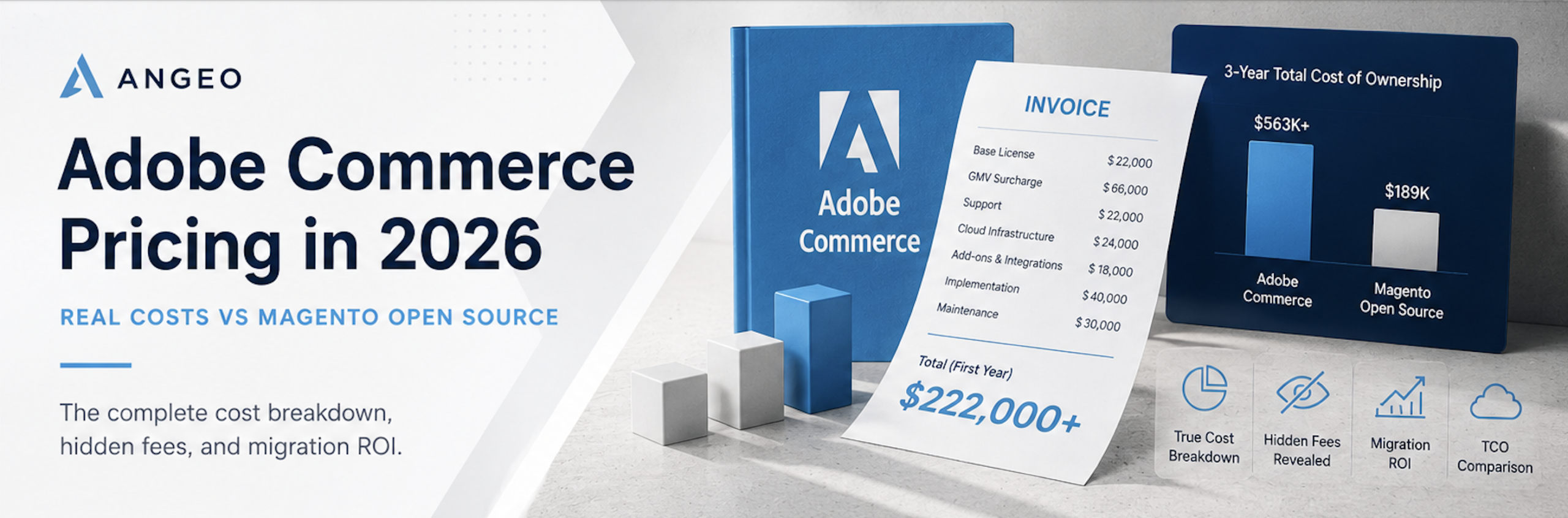
TL;DR — key numbers at a glance
- Adobe Commerce license starts at approximately $22,000–$40,000/year for stores under $1M GMV — but that is only the starting point
- Real annual cost including hosting, support, extensions, and upgrades reaches $100,000–$250,000+ for a mid-size store. Most teams underestimate this.
- Magento Open Source total annual cost for the same store: $40,000–$100,000, with full infrastructure control
- The 5-year cost difference is typically $100,000–$350,000 depending on GMV and contract history
- Adobe Commerce makes financial sense for B2B enterprises above $10M GMV that actively use the B2B Suite — for B2C and lighter B2B use cases, the cost-per-feature equation is worth examining carefully
Jump to section:
How pricing works Adobe Commerce tiers Hidden costs Open Source real cost Pricing comparison 5-year TCO Feature decision matrix When Adobe wins Migration risks Cloud architecture Other platforms Who should NOT migrate Negotiation tips Migration decision Data & sources FAQIf you have tried to find Adobe Commerce pricing online, you already know the problem: Adobe does not publish a price list. Every page ends with “Contact us for a quote.” This is not an accident — the pricing model is complex enough that a single number would be misleading.
This article pulls together what is publicly known from merchant communities, agency experience, and platform migration projects. The goal is not a definitive price tag. The goal is a framework for thinking about the real cost — the visible line items, the ones that surprise you at renewal, and a grounded comparison with Magento Open Source so you can walk into an Adobe sales conversation with realistic expectations.
How Adobe Commerce pricing works
Why Adobe pricing is difficult to estimate publicly
Adobe Commerce pricing is genuinely difficult to publish as a simple price list — and it is worth understanding why before evaluating any specific number. Several structural factors make standardised pricing impractical:
- Contract variability. Each Adobe Commerce contract is individually negotiated. Two merchants with identical GMV and feature requirements can end up with materially different rates based on timing, sales team incentives, and competing bids on the table.
- GMV threshold structure. Adobe uses GMV tiers, but the thresholds themselves are not publicly documented and can shift between contract cycles. A merchant at $4.8M GMV may be in a different tier than the published wisdom suggests.
- Bundled add-ons. Adobe Experience Cloud components — Analytics, Target, Marketo, AEM — are frequently bundled into Commerce contracts at custom rates that bear little resemblance to their standalone list prices.
- Negotiated renewals. Renewal pricing depends heavily on prior contract terms, GMV trajectory, and merchant negotiation. The same store could see a 5% increase, a 25% increase, or a 10% decrease at renewal depending entirely on how the conversation is handled.
- Enterprise procurement dynamics. Larger merchants negotiate through procurement teams with master service agreements, multi-product Adobe contracts, and volume commitments that override standard pricing entirely.
This is why community-aggregated ranges are the best signal available without direct negotiation — and why a written quote from Adobe is the only way to know your actual price.
Pricing model basics
Adobe Commerce uses a GMV-based licensing model — your annual license fee scales with your store’s gross merchandise volume. Two merchants running identical stores can pay very different amounts based on their revenue.
| Product | Hosting | Infrastructure control | Typical use case |
|---|---|---|---|
| Adobe Commerce (on-premise) | You choose and manage | Full | Enterprises with own DevOps team |
| Adobe Commerce Cloud | Included (Adobe-managed) | Limited — Adobe controls the stack | Teams without infrastructure resources |
Most mid-size merchants end up on Adobe Commerce Cloud because managing Magento infrastructure in-house requires significant DevOps investment. This guide focuses on the Cloud product — but the licensing cost structure applies to both.
Adobe Commerce pricing by GMV tier (2026 estimates)
Based on publicly reported figures from merchant communities, agency partners, and platform comparison reports, here are the approximate license cost ranges merchants have reported. These are license costs only — not total cost of ownership.
| Annual GMV | Reported license range / year | Cloud hosting add-on | Approx. total platform cost |
|---|---|---|---|
| Up to $1M | $22,000 – $40,000 | $12,000 – $18,000 | $34,000 – $58,000 |
| $1M – $5M | $40,000 – $75,000 | $15,000 – $25,000 | $55,000 – $100,000 |
| $5M – $25M | $75,000 – $125,000 | $20,000 – $40,000 | $95,000 – $165,000 |
| $25M+ | $125,000 – $300,000+ | Custom | $150,000 – $400,000+ |
The hidden costs of Adobe Commerce
The license and hosting are the visible part of the bill. The invoice shock usually happens later — when mandatory upgrades, support escalations, and extension replacements land in the budget. These are the costs that consistently surprise teams new to the platform.
| Cost category | Typical annual range | Notes |
|---|---|---|
| License | $22,000 – $125,000+ | GMV-based, escalates at renewal as you grow |
| Adobe Cloud hosting | $12,000 – $40,000 | Limited infrastructure control, fixed tiers |
| Priority support SLA | $8,000 – $20,000 | Base support included; faster response costs extra |
| Third-party extensions | $5,000 – $30,000 | Search, PIM, loyalty, advanced checkout — none included |
| Mandatory platform upgrades | $15,000 – $50,000 per major version | Required to maintain security support; dev cost is yours |
| Development & maintenance | $40,000 – $120,000 | Adobe Cloud has more constrained CI/CD workflows and deployment flexibility compared to self-managed infrastructure |
| Adobe Experience add-ons | $30,000 – $80,000 | Analytics, Target, Marketo — often bundled into enterprise contracts |
| Realistic annual total (mid-size store) | $100,000 – $250,000+ | For a store doing $1M–$5M GMV |
What Magento Open Source actually costs
The license is $0. That does not mean the platform is free to run — but the cost structure is fundamentally different, and the key difference is not just the number. It is the control. With Open Source, every line item is a choice. You invest more in development and less in hosting, or vice versa, depending on your priorities. Adobe Commerce locks you into their hosting tier, their upgrade cycle, and their support queue.
| Cost category | Typical annual range | Notes |
|---|---|---|
| License | $0 | MIT-licensed open source |
| Hosting (Hypernode, Cloudways, AWS) | $2,400 – $9,600 | Full control over infrastructure, scaling, CDN |
| Extensions | $3,000 – $15,000 | Wider marketplace, no vendor lock-in, one-time purchases common |
| Development & maintenance | $30,000 – $80,000 | Agency or in-house; full CI/CD and Git deployment freedom |
| Security patches | $0 – $5,000 | Free patches; developer time to apply and test them |
| Support | $0 – $15,000 | Dev partner SLA or in-house — your choice of provider and price |
| Realistic annual total (mid-size store) | $40,000 – $100,000 | For a store doing $1M–$5M GMV |
Adobe Commerce vs Magento Open Source pricing: direct comparison
The numbers side by side, for a store doing $2M GMV annually:
| Cost category | Adobe Commerce Cloud | Magento Open Source | Difference |
|---|---|---|---|
| License | $55,000 – $75,000 | $0 | –$55,000–75,000 |
| Hosting | $18,000 – $25,000 | $4,000 – $8,000 | –$10,000–21,000 |
| Extensions | $8,000 – $20,000 | $5,000 – $15,000 | –$3,000–5,000 |
| Development | $60,000 – $100,000 | $40,000 – $80,000 | –$20,000 |
| Support SLA | $10,000 – $20,000 | $5,000 – $15,000 | –$5,000 |
| Mandatory upgrades (amortised) | $8,000 – $15,000 | $3,000 – $8,000 | –$5,000–7,000 |
| Annual total | $159,000 – $255,000 | $57,000 – $126,000 | $60,000–130,000 saved |
5-year total cost of ownership: three scenarios
License costs compound over time, and Adobe’s GMV-tier escalation means the gap widens as your business grows. Expand each scenario to see the year-by-year picture.
| Year 1 | Year 3 | Year 5 | 5-year total | |
|---|---|---|---|---|
| Adobe Commerce Cloud | $50,000 | $58,000 | $65,000 | ~$290,000 |
| Magento Open Source | $55,000 | $50,000 | $48,000 | ~$255,000 |
| Difference | –$5,000 | +$8,000 | +$17,000 | ~$35,000 saved |
Year 1 Open Source is higher because it includes migration/setup cost (~$20,000–$40,000). From Year 2 onwards Open Source is consistently cheaper. At this store size, the saving is real but modest — the bigger argument for Open Source is flexibility and future-proofing, not immediate savings.
| Year 1 | Year 3 | Year 5 | 5-year total | |
|---|---|---|---|---|
| Adobe Commerce Cloud | $95,000 | $115,000 | $135,000 | ~$560,000 |
| Magento Open Source | $90,000 | $70,000 | $65,000 | ~$375,000 |
| Difference | +$5,000 | +$45,000 | +$70,000 | ~$185,000 saved |
Adobe costs accelerate because GMV growth at this level commonly triggers a tier escalation by Year 2–3. The Open Source migration pays for itself within 12–18 months for most stores in this range.
| Year 1 | Year 3 | Year 5 | 5-year total | |
|---|---|---|---|---|
| Adobe Commerce Cloud | $160,000 | $190,000 | $220,000 | ~$950,000 |
| Magento Open Source | $150,000 | $110,000 | $100,000 | ~$580,000 |
| Difference | +$10,000 | +$80,000 | +$120,000 | ~$370,000 saved |
At this GMV level, the Open Source saving over 5 years funds a substantial additional development budget — typically enough to build custom features that would have cost additional Adobe add-on licenses.
Estimate your break-even point
Enter your figures to see an estimated 5-year comparison and when Open Source migration would pay for itself.
Adobe hosting = 25% of license cost (based on reported Adobe Cloud tier patterns) · Adobe annual cost growth = illustrative assumption based on reported renewal increases and GMV-tier escalations (select range above) · Open Source hosting = $6,000/yr fixed (Hypernode mid-tier reference) · Open Source dev = your current dev budget × complexity multiplier · Migration cost = Open Source dev × 0.6 (one-time, based on reported migration projects) · These are directional estimates, not quotes — your actual numbers will vary.
Adobe Commerce vs Magento Open Source: feature decision matrix
The real question is not “which platform is cheaper” but “which features am I paying the Adobe premium for, and are there alternatives?” Here is a cost-per-feature breakdown for the proprietary components that make up most of the Adobe Commerce value proposition.
| Adobe feature | Included in Adobe Commerce? | Best Open Source alternative | Alternative cost / yr | Worth Adobe premium? |
|---|---|---|---|---|
| B2B Suite — company accounts, quote management, requisition lists, shared catalogues | ✓ Included | Mageworx / Amasty B2B extensions | $5,000–$15,000 | Only if used heavily in daily operations |
| Adobe Sensei AI — product recommendations, visual search, predictive search | ✓ Included | Klevu, Nosto, Constructor.io | $12,000–$40,000 | Only if Adobe’s model outperforms alternatives for your catalogue |
| Visual Merchandiser — drag-drop category management | ✓ Included | Custom dev or Amasty extension | $2,000–$5,000 one-time | Usually inexpensive to replicate in Open Source |
| Page Builder — visual CMS for non-technical teams | ✓ Included | Hyvä Themes + custom CMS, or headless CMS | $5,000–$20,000 setup | Only if marketing team self-manages content at scale |
| Adobe Experience Manager integration | Add-on (extra cost) | Contentful, Storyblok, Sanity | $10,000–$30,000 | No — only if already committed to Adobe ecosystem |
| Adobe Analytics + Target | Add-on (extra cost) | GA4 + Optimize (free) or Mixpanel | $0–$15,000 | For many mid-size merchants, GA4 + third-party tooling covers most reporting needs |
| Adobe-managed infrastructure SLA | ✓ Cloud product | Hypernode managed hosting + support contract | $5,000–$15,000 | Only if you have zero DevOps capacity |
| Gift Cards module | ✓ Included | Multiple marketplace extensions | $500–$2,000 one-time | Rarely sufficient alone to justify Adobe premium |
When Adobe Commerce is worth the price
This is not an argument that Adobe Commerce is always the wrong choice. There are genuine scenarios where the premium is justified — and saying so clearly is important for anyone using this article to make an actual decision.
- B2B enterprises above $10M GMV that run complex quote workflows, company account hierarchies, and requisition list management daily — the B2B Suite is genuinely difficult to replicate at that scale
- Teams already deeply embedded in Adobe Experience Cloud — if you are running AEM, Adobe Analytics, and Adobe Target as an integrated stack, migrating just the commerce layer creates integration debt that may cost more than the license saving
- Organisations without technical ownership — if there is no internal developer and no plan to build a dev partner relationship, Adobe’s managed infrastructure and support queue is a real service, not just overhead
- Multi-region enterprise deployments with complex localisation, tax, and catalogue requirements that have been specifically built into Adobe Commerce’s architecture over years — migration risk is real and the cost of getting it wrong is high
Real migration risks merchants underestimate
This article spends a lot of time on the financial case for migration. That picture is incomplete without an honest look at the operational risks. Migrations fail or overrun — and when they do, the platform saving you calculated never materialises because the cost of fixing the migration eats it. Anyone considering this move should price these risks into their decision.
| Risk area | What goes wrong | Mitigation |
|---|---|---|
| Extension parity | Adobe Commerce extensions you rely on may not have direct Open Source equivalents — or the equivalents work differently. Custom rework can balloon scope by 30–50%. | Full extension inventory and parity assessment before committing to migration timeline. |
| Checkout conversion regression | Even minor checkout differences post-migration can drop conversion rates 5–15% in the first weeks while you debug. For a $2M GMV store, that is $8K–$25K of lost revenue per month. | A/B test the new checkout in parallel before full cutover; have rollback plan ready. |
| SEO volatility | URL structures, schema, and meta data can shift during migration. Organic traffic dips of 10–30% in the first 4–8 weeks are common, sometimes longer. | 1:1 URL mapping, redirect strategy, schema preservation audit before go-live. |
| ERP and integration edge cases | Order sync, inventory updates, accounting integration — these often have undocumented quirks tied to specific Adobe Commerce behaviours. Edge cases surface after go-live. | Stage all integrations in a sandbox replica of production for at least 2 weeks before cutover. |
| Timeline overruns | Most migrations run 30–60% over original timeline estimates. Reasons compound: extension issues, data cleanup surprises, QA scope expansion. | Build 30% buffer into the timeline from day one; phase the migration if possible. |
| QA scope explosion | Every customisation needs retesting against the new platform. For stores with 3–5 years of accumulated customisation, QA can take longer than the development itself. | Automated regression test suite for critical user journeys before migration starts. |
| Data cleanup surprises | Legacy product data, deprecated attribute sets, orphaned records — these have to be reconciled. Often only discovered during migration itself. | Run a data audit phase as part of the technical assessment, not during migration. |
Adobe Cloud architecture: what CTOs should evaluate
The financial comparison only goes so far. For technical leaders, the architectural differences between Adobe Commerce Cloud and self-managed Magento Open Source matter as much as the cost — and they affect both the migration decision and what’s possible after.
- Restricted infrastructure access. Adobe Cloud limits direct SSH access, file system manipulation, and underlying service configuration. Standard troubleshooting workflows that are routine on self-managed infrastructure require Adobe support tickets — adding hours or days to resolution times.
- Deployment pipeline constraints. Adobe Cloud’s deployment model uses Adobe’s specific pipeline (the Cloud CLI and Magento Cloud Tools). You can integrate with Git providers, but the deployment workflow itself is shaped by Adobe’s architecture — not your team’s preferred CI/CD tooling.
- Environment scaling controls. Cloud environments scale according to Adobe’s tier definitions. You cannot independently provision a larger database server, add more application nodes, or restructure caching without moving to a higher Cloud tier.
- Observability stack lock-in. Adobe Cloud provides New Relic and Adobe-specific monitoring. Integrating your preferred APM, log aggregation, or alerting stack is possible but works around Adobe’s defaults rather than replacing them.
- Patching and version cadence. Security patches and version upgrades are coordinated with Adobe’s release schedule. You apply them on their timeline, not yours.
None of these are deal-breakers individually — and for teams without internal DevOps capacity, Adobe Cloud’s managed approach is a real advantage. The question is whether the constraints align with your engineering culture. Teams with strong infrastructure engineering tend to find Adobe Cloud’s constraints expensive in productivity terms; teams without DevOps capacity often find the same constraints a feature.
How Adobe Commerce pricing compares to other enterprise platforms
Adobe Commerce vs Magento Open Source is the most common comparison merchants run — but it’s not the only relevant frame. Two cross-platform comparisons that often come up:
| Platform | Annual cost (mid-size store) | Strengths vs Adobe Commerce | Trade-offs |
|---|---|---|---|
| Shopify Plus | $24,000–$30,000+ base, plus app costs | Faster time-to-market, lower hosting concerns, broad app ecosystem | Less customisation depth; transaction fees apply outside Shopify Payments; weaker for complex B2B |
| BigCommerce Enterprise | $25,000–$80,000/year | No transaction fees, strong B2B Edition, simpler operationally than Adobe | Smaller agency ecosystem; less mature for very large catalogues or complex multi-store setups |
| Magento Open Source | $40,000–$100,000/year (full cost) | Maximum flexibility, large agency ecosystem, no platform license fee | Higher operational complexity; requires technical ownership |
| Adobe Commerce Cloud | $100,000–$250,000+/year | Most powerful B2B Suite, deepest Adobe ecosystem integration, managed infrastructure | Highest cost; deployment and infrastructure constraints |
Who should NOT migrate to Magento Open Source
Most migration articles skip this section. They shouldn’t. Not every Adobe Commerce store should migrate — and recommending migration to the wrong business causes real damage. Here are the situations where staying makes more sense than moving.
Do not migrate if any of these apply
- You actively use Adobe B2B Suite in daily operations. Complex company account hierarchies, quote workflows across multiple buyer roles, and requisition lists that your sales team relies on daily — replacing this in Open Source requires custom development that can cost $40,000–$100,000 and take 6–9 months. The migration saving may not cover it.
- Your GMV is growing fast enough that migration distraction is expensive. A migration takes 3–6 months of significant dev attention. If you are in a growth phase where that attention would otherwise go to conversion optimisation or new market expansion, the opportunity cost may outweigh the platform saving.
- You have no technical ownership and no plan to build it. Open Source requires someone — internal or agency — who understands infrastructure, deployment, security patching, and Magento development. If you currently rely entirely on Adobe support, moving to Open Source without a dev partner in place is trading a managed risk for an unmanaged one.
- You are locked into Adobe Experience Cloud at the organisation level. If Adobe Analytics, AEM, and Marketo are company-wide decisions made above the eCommerce team, migrating the commerce platform creates integration complexity that extends well beyond the store itself.
- Your current customisations are deeply tied to Adobe-only APIs. Some stores have been on Adobe Commerce for 5–8 years and have significant custom code built on Adobe-specific extension points. A technical audit may reveal that the Open Source migration scope is much larger than the license saving justifies.
Negotiating Adobe Commerce pricing
Adobe Commerce is not a SaaS product with a fixed price list. Contracts are negotiated — and merchants who approach renewal as a negotiation consistently report better outcomes than those who accept the invoice.
-
Start 90 days before renewal, not 30
Adobe’s sales team has significantly more flexibility early in the window. At 30 days out, the leverage shifts to Adobe — they know you are unlikely to complete a migration before expiry.
-
Get a competing Open Source migration quote first
Even if you do not plan to migrate, a concrete assessment from a Magento Open Source partner gives you a documented alternative. This is the single most effective lever reported by merchants who have successfully negotiated Adobe renewals.
-
Challenge GMV tier escalation specifically
Ask for written documentation of what additional platform value the higher tier provides. Many merchants successfully hold their current tier pricing for one renewal cycle by simply asking and demonstrating that their usage pattern has not changed.
-
Negotiate add-ons rather than the base price
Merchants report more success getting Adobe Experience add-ons (Analytics, Target) included at no cost for a year than getting direct license reductions. If you were going to pay for those anyway, the effective saving is identical.
-
Consider multi-year pricing if you plan to stay
A 2–3 year contract often unlocks 10–20% pricing stability and freezes your GMV tier for the contract term — removing the renewal escalation risk if your store is growing.
Should you stay on Adobe Commerce or migrate?
Stay on Adobe Commerce if…
- You actively use the B2B Suite in daily sales operations
- Your marketing team self-manages content via Page Builder without developer involvement
- You are deeply integrated with Adobe Experience Cloud at the organisation level
- You have no internal dev team and no plan to build one or hire an agency
- Your GMV is growing fast enough that migration distraction costs more than the platform saving
- Custom code is deeply tied to Adobe-specific APIs (validate with a technical audit first)
Migrate to Open Source if…
- Your license is $40,000+/year but you only use core B2C catalog and checkout features
- Your dev team is constrained by Adobe Cloud deployment restrictions
- A mandatory upgrade is incoming that will cost $20,000–$50,000 in development
- Your GMV growth is pushing you toward a higher tier at next renewal
- You want headless or composable architecture that Adobe Cloud restricts
- You want full infrastructure ownership and control over release cycles
Break-even calculation
Migration from Adobe Commerce to Magento Open Source typically costs $30,000–$80,000 as a one-time project — technical audit, data migration, module replacement, testing, go-live. At annual savings of $40,000–$80,000 for a mid-size store, the break-even point is typically 9–18 months from go-live.
After break-even, every year on Open Source returns the full annual saving. For a store at $2M GMV, that is typically $50,000–$80,000 per year — available to reinvest in development, marketing, or AEO optimisation.
For the full migration process walkthrough: Migrating from Adobe Commerce to Magento Open Source: Is it worth it? →
Data behind this article
Based on migration assessments and community data (2024–2026)
The cost ranges and scenarios in this article are grounded in a combination of first-hand migration project data and aggregated community sources. Adobe Commerce does not publish pricing, which makes cross-referencing multiple independent sources essential for any useful estimate.
First-hand data:
- Migration assessments and scoping projects completed between 2024–2026, covering stores in the $500K–$10M GMV range across EU and UK markets
- Contract renewal figures shared by merchants during advisory engagements (anonymised in all examples)
- Based on these assessments: average projected annual saving after migration was 41% of prior Adobe Commerce total spend, with a median break-even of 14 months
- Sample is directional — store complexity, B2B requirements, and existing customisation depth significantly affect individual outcomes
Community and public sources:
- Merchant discussions: r/Magento and r/ecommerce on Reddit
- Platform reviews: Adobe Commerce on G2 and Clutch eCommerce agency reports
- Official documentation: Adobe Commerce developer docs, Magento Open Source dev docs
- Hosting reference: Hypernode Magento hosting pricing
- Platform source: Magento Open Source on GitHub
- Community: Mage-OS ecosystem partner and contributor network
Last reviewed: May 2026. Figures will be updated as new data becomes available. Always request a direct quote from Adobe for your specific contract situation.
angeo.dev
Magento architect · AEO specialist · Open Source migration consultant
Working in the Magento ecosystem since 2016 — platform migrations, performance architecture, and AI visibility optimisation for eCommerce stores across EU and UK markets. Migration projects across the $500K–$10M GMV range. Open source contributor.
Key takeaways for CFOs and finance teams
- Adobe Commerce license cost is not fixed — it escalates at renewal as GMV crosses tier thresholds. Budget for 15–40% increases if your store is growing.
- The license is typically 30–40% of total platform cost. Hosting, development, extensions, and mandatory upgrades make up the rest — and these are rarely included in the initial sales conversation.
- Mandatory major version upgrades are a recurring capex item — budget $20,000–$50,000 every 2–3 years regardless of whether you add new features.
- A migration to Magento Open Source is a capital project with a defined payback period — typically 9–18 months — after which it reduces annual opex by $40,000–$130,000 depending on GMV.
- The most effective time to negotiate Adobe pricing is 90 days before contract renewal, with a competing migration quote in hand.
Questions to ask Adobe before signing a renewal
- What specific features am I paying for that are not available in Magento Open Source? Ask for a written list. If the answer is mostly B2C features you already have in core, that is useful information.
- Why has the price increased from last year? If your GMV crossed a tier, ask for documentation of what additional platform value that tier includes.
- What is the pricing if I commit to a 2-year or 3-year contract? Multi-year pricing often unlocks stability and freezes GMV tiers.
- What is included in the hosting tier? Ask specifically: how many environments, what CPU/RAM limits, what happens if you exceed them.
- What is the end-of-life timeline for the current version? This tells you when the next mandatory upgrade cost will land.
- Can Adobe include Analytics or Target at no cost for the contract term? Add-ons are more negotiable than the base license.
- What is the process if I want to move to on-premise instead of Cloud? Understanding exit options gives you leverage even if you don’t intend to use them.
Adobe Commerce pricing red flags
These are patterns reported by merchants that warrant a closer look before signing:
- Renewal quote arrives less than 60 days before expiry. This is a negotiation tactic — less time means less leverage. Push back and ask for a 30-day extension to evaluate alternatives.
- Price increase is attributed to “platform improvements” without specifics. Ask for a written changelog of what changed in the platform that justifies the price increase.
- Adobe Experience add-ons are bundled into the contract without explicit line items. Make sure you know what you are paying for — and whether you are actually using it.
- The hosting tier was upgraded without your request. Adobe sometimes moves stores to higher hosting tiers at renewal citing traffic growth. Check whether the move is justified by your actual traffic data.
- The GMV tier calculation uses projected GMV rather than trailing 12 months. Some contracts are priced on forecast growth. Negotiate to use actual trailing GMV as the basis.
- You cannot get a straight answer on end-of-life timelines for your current version. Adobe’s security support windows directly affect when your next mandatory upgrade cost will land.
Not sure whether your Adobe renewal is justified?
If your contract is coming up for renewal — or if you just received an invoice that was higher than expected — it is worth getting a migration feasibility estimate before signing for another year.
The free audit covers your store’s technical readiness, extension dependencies, and a migration scope estimate — so you walk into the renewal conversation with real numbers, not guesses.
0 Comments