Your Magento store is already doing everything right — for Google. Fast load times, clean structure, solid content, good rankings. But AI systems evaluate different signals. When someone asks ChatGPT for exactly what you sell, your store may not appear — not because your SEO is wrong, but because AI visibility requires an additional machine-readable layer that most Magento stores haven’t set up yet.
- Google ranks you. AI engines decide if you exist.
- SEO alone is not enough for AI visibility — AI systems still use web signals, but require additional structured layers most stores lack.
- AI uses different signals: robots.txt access, structured schema, llms.txt, product feeds.
- A store with excellent SEO and zero AEO work scores ~23% on AI visibility — blocked by default.
- The fix takes under 2 hours and uses free open-source Magento modules.
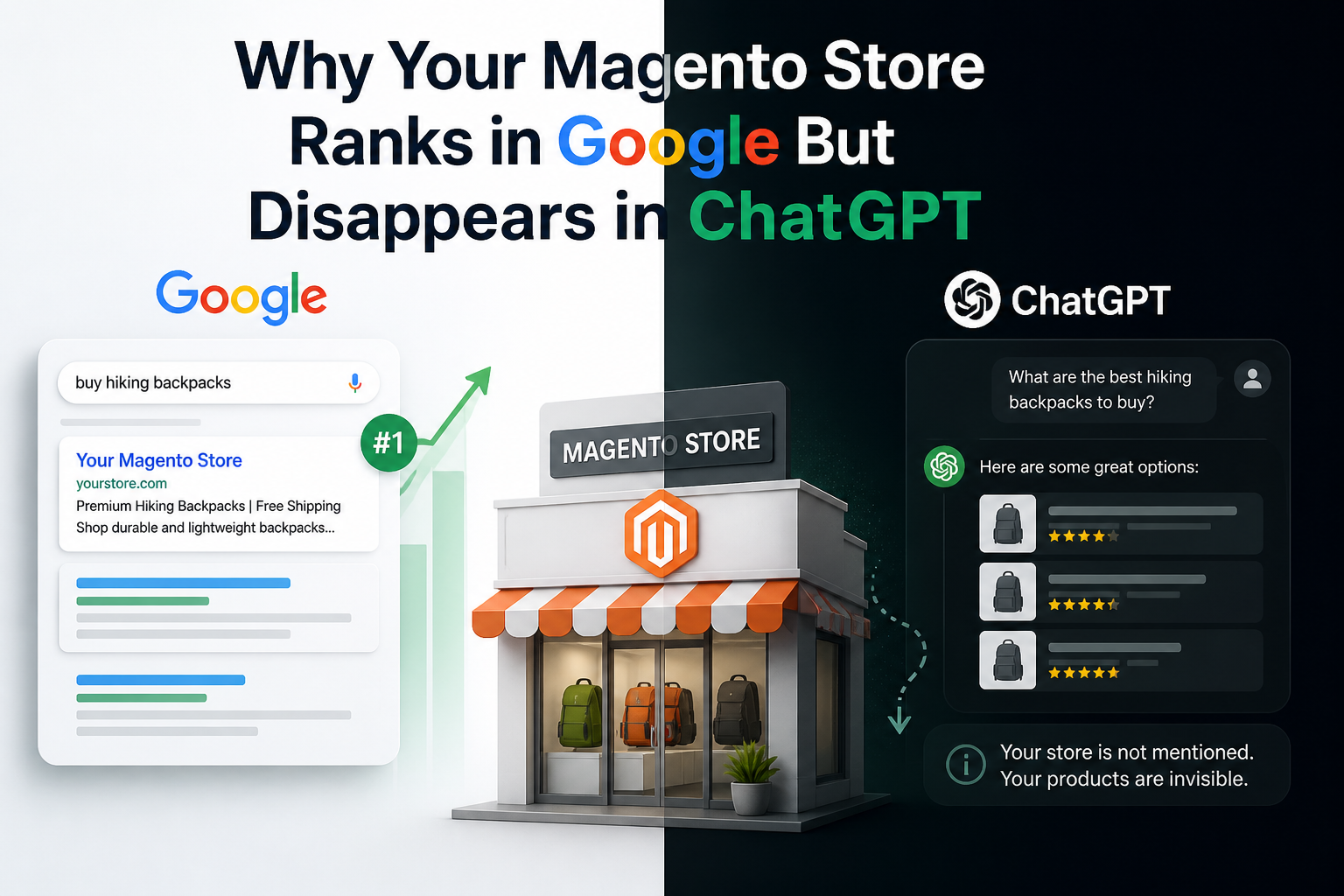
Two Different Questions
Google and ChatGPT are answering two fundamentally different questions when a user searches for something.
Result: a ranked list of links. You click, browse, decide.
ChatGPT asks: “What should this person buy, and where can they buy it?”
Result: a recommendation. Either your store is in it — or it isn’t.
This distinction matters because these two questions require fundamentally different answers from your store’s infrastructure. AI systems still use web signals — authority and content quality still matter — but they also require machine-readable layers that traditional SEO work doesn’t address.
This distinction matters more than most Magento store owners realise. When ChatGPT recommends a product, the user doesn’t comparison-shop across ten results. They follow the recommendation. Conversion rates from AI-referred traffic are significantly higher than from organic search — because the filtering already happened before the click.
But to get into that recommendation, you have to play by AI’s rules. And those rules have almost nothing to do with the SEO work you’ve been doing for years.
What Google Cares About vs What AI Cares About
Notice that almost none of the AI signals overlap with traditional SEO. Your domain authority, your backlink profile, your Core Web Vitals score — none of these directly affect whether ChatGPT or Perplexity recommends your store. They are measuring completely different things.
The Specific Problem with Default Magento
Default Magento 2 was designed before AI search existed. Its configuration makes perfect sense for Google — but creates a specific set of problems for AI engines.
Problem 1: robots.txt blocks AI crawlers by default
Most Magento installations have a robots.txt that was set up years ago and never touched since. It typically allows Googlebot and Bingbot — and says nothing about the AI crawlers that have emerged in the last two years.
When a bot is not explicitly mentioned in robots.txt, behavior depends on your wildcard rules. In many Magento setups, AI crawlers like OAI-SearchBot (ChatGPT) and PerplexityBot are either blocked or not explicitly allowed — which can result in limited or inconsistent crawling.
Check yours right now:
curl https://yourstore.com/robots.txt | grep -E "OAI-SearchBot|PerplexityBot|Google-Extended"If you get no output, those bots have no explicit permission. Depending on your wildcard rules, they may be blocked entirely. This is the single most common reason a well-optimised Magento store is invisible in AI search — and it takes five minutes to fix.
Problem 2: Product schema is missing the one field AI needs most
Magento’s default product templates output microdata — the older HTML attribute format. AI engines prefer JSON-LD. More critically, the default microdata is missing offers.availability.
This one missing field causes ChatGPT Shopping feed validation to fail automatically. The product technically exists in ChatGPT’s index, but it cannot be shown as a purchasable item. For a shopping recommendation engine, a product that can’t be confirmed as purchasable simply doesn’t get recommended.
The correct format is:
"availability": "https://schema.org/InStock"Not "In Stock", not "instock", not true. The full schema.org URI. AI parsers silently reject everything else.
Problem 3: No llms.txt means AI crawlers are guessing
When an AI crawler visits your store without llms.txt, it parses random product pages and tries to infer what your store is about. This works poorly for ecommerce — navigation menus, cookie banners, related products, and promotional banners all create noise that obscures the actual product data.
llms.txt is a plain text file at your store root that tells AI engines exactly what you sell, what your main categories are, and which pages are most important. Perplexity has specifically documented it as a crawl signal. Without it, discovery is slower, less accurate, and less complete.
Problem 4: ChatGPT Shopping requires a separate feed
ChatGPT Shopping product cards — the feature that shows prices, images, and buy links directly in a chat response — are not populated from organic crawl. They require a separate ACP (Agentic Commerce Protocol) product feed submitted to OpenAI’s merchant program.
Good Google SEO, good organic rankings, even a perfect product page — none of these get you into ChatGPT Shopping. It requires a deliberate registration process and a spec-compliant feed.
A store can appear in ChatGPT’s general answers (via OAI-SearchBot crawl) without appearing in Shopping product cards (which require ACP feed registration). These are two separate paths to AI visibility.
How AI Decides What to Recommend
Understanding why AI visibility requires different signals starts with understanding how AI shopping systems make decisions. The process has five layers — and a store needs all of them to be eligible for product recommendations:
- Crawl access — AI crawlers must be able to reach your pages. If
robots.txtblocks or doesn’t explicitly allow AI bots, the process stops here. - Structured data confidence — AI parsers need Product JSON-LD with valid fields to understand what you’re selling. Ambiguous or incomplete schema is treated as unreliable.
- Product availability — Without
offers.availabilityset to a schema.org URI, AI cannot confirm a product is purchasable. An unconfirmed product doesn’t get recommended. - Merchant trust signals — Organization schema, consistent brand identity, and
llms.txthelp AI systems verify who is selling the product. - Feed presence — For ChatGPT Shopping product cards specifically, a registered ACP product feed is required. Organic crawl alone is not enough for shopping results.
Most Magento stores pass layers 2 and 3 partially — but fail at layers 1, 4, and 5 entirely. This is why strong SEO doesn’t automatically translate into AI visibility: SEO optimizes for a different decision process.
The Pattern Across Magento Stores
In audits across Magento stores, the pattern is consistent: strong SEO, invisible in AI results.
A store with excellent domain authority, page one rankings, and years of SEO investment can score 23% on AI visibility — because it blocks OAI-SearchBot in robots.txt, has no llms.txt, and outputs microdata without offers.availability. None of these issues show up in a Google audit. All of them block AI visibility entirely.
Meanwhile, a newer store that spent an afternoon on AEO — allowed AI crawlers, added JSON-LD schema, generated llms.txt — scores 79% and appears in ChatGPT results for the same queries.
SEO authority doesn’t transfer to AI recommendations. The technical layer is what matters — and it’s almost entirely within your control.
The AEO Score: Where Most Magento Stores Stand Today
Based on auditing 50+ Magento stores, the average AEO score for a store that has done zero AI-specific work is around 21–28%. Here is a representative example of what a real audit looks like before and after fixes:
Before: OAI-SearchBot blocked in robots.txt · Product schema: microdata only, no availability · llms.txt: missing · ACP feed: missing
Score: 26%
After: AI bots allowed · JSON-LD with offers.availability · llms.txt generated · ACP feed submitted
Score: 81%
Time to implement: approximately 90 minutes.
Here is what the signal breakdown typically looks like across default Magento installations:
| Signal | Default Magento status | Impact |
|---|---|---|
| robots.txt — AI bot access | Usually blocked | Zero crawl visibility |
| llms.txt | Missing | Poor catalog discovery |
| Product JSON-LD schema | Partial (microdata, no availability) | Shopping feed fails |
| AI product feed (ACP) | Missing | No ChatGPT Shopping cards |
| Organization schema | Missing | Weak merchant trust |
| sitemap.xml | Usually present | — |
| Open Graph tags | Partial | — |
| Canonical tags | Usually present | — |
The good news: the four failing signals — robots.txt, llms.txt, Product schema, and ACP feed — are all fixable with free open-source Magento modules. The bad news: most stores haven’t fixed them yet, which means the window for early-mover advantage is still open.
What Fixing It Looks Like
These fixes can be implemented manually by editing templates and configuration files directly. Using modules significantly speeds up the process — here is the fastest path:
# Step 1: Fix robots.txt — allow AI crawlers
composer require angeo/module-robots-txt-aeo

# Step 2: Generate llms.txt and llms.jsonl
composer require angeo/module-llms-txt

# Step 3: Fix Product schema + Organization schema
composer require angeo/module-rich-data

# Step 4: Generate ACP product feed for ChatGPT Shopping
composer require angeo/module-openai-product-feed angeo/module-openai-product-feed-api

bin/magento setup:upgrade && bin/magento cache:flush
Total time including reading the docs: under 90 minutes. ChatGPT Shopping registration (at chatgpt.com/merchants) requires a separate application and is currently US-focused — but fixing the technical layer first means you’re ready the moment eligibility expands.
To see exactly what’s blocking your store before you start:
composer require angeo/module-aeo-audit
bin/magento setup:upgrade && bin/magento cache:flush
bin/magento angeo:aeo:audit
This gives you a weighted score across 13 signals with the exact fix command for each failure.
Why This Is Happening Now
AI shopping is not growing gradually — it’s being injected directly into existing user behavior. ChatGPT has over 400 million weekly users. Perplexity has become the default search for a significant segment of tech-savvy buyers. Google’s AI Overviews appear on the majority of commercial queries.
The shift is not “AI search will matter in a few years.” It’s “AI search is already part of how your potential customers look for products today.” The stores that haven’t adapted yet aren’t missing a future opportunity — they’re invisible in a channel that already exists.
What makes this moment unusual is that the competition is still minimal. Most Magento stores have done nothing on AEO. The technical fixes are straightforward and free. The window where early movers have a significant advantage over the field is open — but it won’t stay open indefinitely.
The Bigger Picture
AI search is not replacing Google. Both will coexist — and both require different optimisation work. The stores that move first on AEO while their competitors are still focused exclusively on Google SEO have a significant advantage: less competition for AI recommendations, lower cost of visibility, higher-intent traffic.
In 2023, everyone was talking about doing SEO. In 2025, the conversation shifted to “why isn’t my store in ChatGPT?” In 2026, the stores that fixed their technical AEO layer in 2025 are already seeing results. The stores that are asking the question now are six to twelve months behind — but not too late.
The technical layer is table stakes. Without it, content quality, product range, pricing strategy, and brand strength don’t matter — you’re invisible by default. With it, all of those things start to count.
Check Your Store’s AEO Score
The full AEO guide covers every signal in detail. To see exactly where your store stands:
- Free web-based self-assessment — no installation required
- CLI audit module — checks all 13 signals with fix commands
- robots.txt fix guide — the highest-impact single change
- Product schema guide — how to fix
offers.availability
See why ChatGPT isn’t recommending your store
One CLI command. 60 seconds. No account. No data sharing. Returns a score from 0–100 with the exact fix for each failing signal.
0 Comments